Electric Forklift for Long Loads: Side Loader vs Multi-Directional Forklift
Nov 25, 2026
Moving long materials such as steel pipes, timber, aluminum profiles, metal sheets, and structural components requires more than a standard forklift. The longer the load, the more difficult it becomes to turn, position, and transport it safely through warehouse aisles. A conventional forklift may have sufficient lifting capacity but still require excessive maneuvering space when carrying long goods.
An electric forklift for long loads is designed to address these handling challenges. Two common equipment options are side loader forklifts and multi-directional forklifts. Both can transport long materials, but they use different movement and handling principles. The right choice depends on load length, weight, warehouse aisle width, storage layout, lifting height, and the frequency of material movement.
Bespoke Forklifts provides electric and diesel multi-directional forklifts in narrow-body and wide-body configurations, with rated capacities ranging from 1.5 to 5.0 tons and lifting heights from 3 to 8 meters across its product range. These machines are designed for industries handling steel, pipes, profiles, timber, and other long materials.
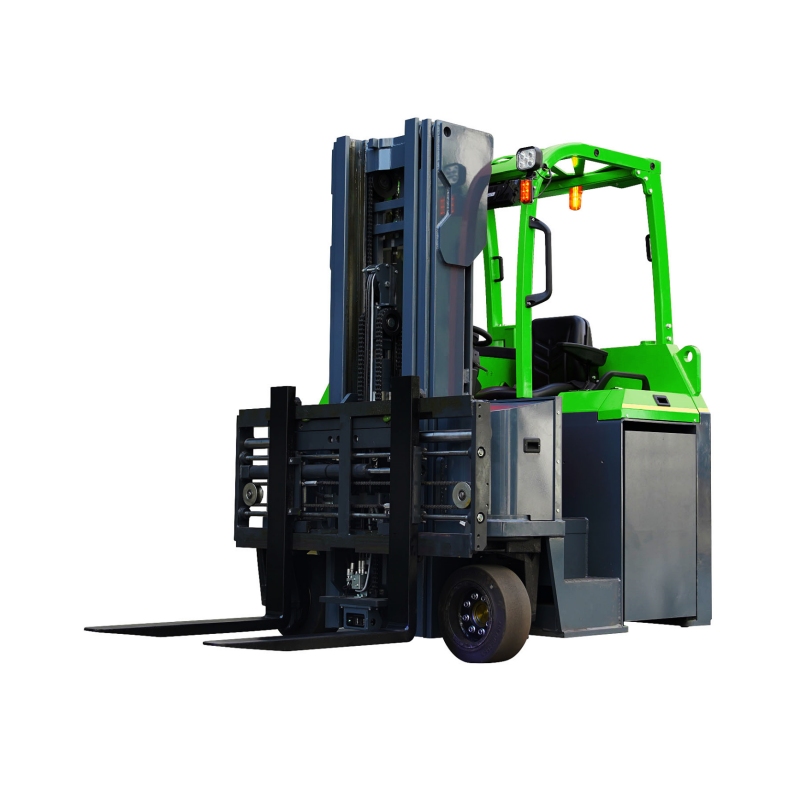
Electric multi-directional forklift for transporting long and bulky materials.
Why Do Long Loads Require Specialized Forklifts?
Long materials behave differently from standard palletized goods during transportation. When a forklift carries a long load in front of the vehicle, the load increases the space required for turning and maneuvering. Even if the forklift itself is relatively compact, the combined length of the truck and cargo can make narrow aisles difficult to navigate.
This creates several practical problems for warehouse operators:
Large turning space: Long materials require more clearance when the forklift changes direction.
Limited aisle access: Standard counterbalance forklifts may struggle to enter narrow storage aisles with long loads.
Load instability: Long or unevenly distributed materials can create additional stability challenges.
Reduced storage density: Wider handling aisles can reduce the available space for material storage.
Repeated repositioning: Operators may need additional movements to align long materials with racks or production areas.
Safety concerns: Extended loads can obstruct visibility and increase the risk of contact with racks, equipment, or nearby workers.
For example, a steel distributor handling 6-meter metal profiles needs to move materials from the receiving area to storage racks and then to cutting or processing stations. A standard forklift may require the operator to turn the entire vehicle and load together, which can be difficult in a restricted workspace.
A specialized side loader or multi-directional forklift offers a more practical handling method by keeping long materials aligned with the vehicle during transportation.
What Is an Electric Side Loader Forklift?
A side loader forklift is a specialized material handling vehicle designed to carry long loads alongside its chassis rather than extending them forward in the conventional forklift position. Its loading arrangement allows long materials to be transported through narrow spaces while keeping the cargo supported along the vehicle.
Traditional side loaders commonly use a side-mounted lifting platform or fork arrangement. The operator loads materials from the side, lifts them onto the carrying platform, and transports them longitudinally through the warehouse.
This configuration is particularly useful for handling:
Long steel bars and metal sections
Timber and wooden boards
Aluminum profiles
Steel pipes and tubes
Construction materials
Long industrial components
One important point is that a conventional side loader and a multi-directional forklift are not exactly the same machine. A conventional side loader carries the load alongside the chassis, while a multi-directional forklift changes its wheel direction to travel forward, sideways, or diagonally.
Some manufacturers also use the term multi-directional side loader for equipment that combines long-load handling with multi-directional travel. Therefore, buyers should compare the actual vehicle structure and steering functions instead of relying only on the product name.
What Is an Electric Multi-Directional Forklift?
An electric multi-directional forklift is designed to move in multiple directions without requiring conventional turning movements for every change of travel direction. Depending on the model, the wheels can be configured for straight travel, sideways travel, diagonal movement, and in-place rotation.
This makes the equipment particularly useful for transporting long loads through narrow aisles and positioning them in storage racks.
Narrow-body electric multi-directional forklift configuration.
Unlike a conventional forklift that primarily travels forward and backward, a multi-directional forklift can change its movement mode to match the load and working environment.
For example, when transporting long steel profiles, the operator can use sideways travel to keep the material aligned with the direction of movement. When approaching a loading area, the operator can switch to forward travel for positioning or unloading.
Bespoke Forklifts offers several electric multi-directional forklift configurations, including narrow-body stand-on, narrow-body seated, and wide-body models. Depending on the model, rated capacity ranges from 1.5 to 5.0 tons, with lifting heights from 3 to 10 meters for certain narrow-body configurations.
View the Electric and Diesel Multi-Directional Forklift Range to compare different configurations for long material handling.
Side Loader vs Multi-Directional Forklift: Key Differences
The main difference between a side loader and a multi-directional forklift is how the vehicle carries the load and changes direction during operation.
A side loader transports long materials alongside the chassis, while a multi-directional forklift uses specialized steering to move in different directions. Both can reduce the maneuvering difficulties associated with long materials, but their suitability depends on the handling process.
Comparison
Side Loader Forklift
Multi-Directional Forklift
Load position
Alongside the chassis
On forks with multiple travel orientations
Travel direction
Primarily longitudinal travel
Forward, sideways, diagonal, and in-place rotation, depending on model
Long-load handling
Carries long materials alongside the vehicle
Moves long materials sideways while maintaining alignment
Warehouse layout
Long storage aisles and dedicated loading areas
Narrow aisles and flexible storage layouts
Load positioning
Side loading and longitudinal transport
Flexible approach and positioning from different directions
Typical applications
Timber yards, steel storage, long-product warehouses
Steel profiles, pipes, aluminum sections, compact warehouses
Best selection factor
Load length and side-loading workflow
Aisle restrictions and multi-directional handling requirements
For warehouses where long materials need to be transported through restricted aisles and stored in high-density racks, a multi-directional forklift can offer greater flexibility. For operations that primarily load and unload long materials from the side of the vehicle, a conventional side loader may be more appropriate.
The decision should be based on the complete material handling process, including receiving, storage, retrieval, and delivery to production lines.
How Does Multi-Directional Steering Improve Long Load Handling?
Multi-directional steering reduces the need to turn the entire forklift and its load together. This is especially important when transporting long products that extend beyond the vehicle's normal body dimensions.
Depending on the steering system, the forklift can operate in several movement modes:
Straight travel: The forklift moves forward or backward for general transportation and approach movements.
Sideways travel: The vehicle moves laterally while keeping long materials aligned with the chassis. This is useful when entering narrow storage aisles.
Diagonal travel: The forklift can move at an angle to adjust its position in restricted working areas.
In-place rotation: Certain multi-directional configurations allow the vehicle to rotate within a very limited space, reducing the need for large turning areas.
Multi-directional forklift structure for flexible long-load positioning.
For example, a warehouse storing 6-meter steel profiles in parallel racks can use sideways travel to move the materials along the aisle without making a conventional forward turn with the full load projecting ahead of the truck.
This can reduce the space needed for maneuvering and make warehouse layout planning more flexible. However, the actual aisle width must still be calculated according to the truck dimensions, load overhang, rack clearance, and operating method.
Which Electric Multi-Directional Forklift Configuration Should You Choose?
Not every long-load warehouse requires the same forklift structure. Bespoke Forklifts provides several multi-directional configurations to accommodate different load weights, operator preferences, and working environments.
Narrow-body electric stand-on multi-directional forklift
The stand-on configuration is suitable for warehouses where compact vehicle dimensions and frequent material handling are important. It can be considered for narrow aisles and operations requiring regular loading and unloading of long materials.
The NRQ series has a rated capacity range of 1.5 to 3.0 tons and a lifting height range of 3 to 10 meters. The NRQZ20 specification listed on the website includes a 2,000 kg capacity and a maximum lifting height of 10,000 mm.
Explore the Narrow Body Electric Stand-On Multi-Directional Forklift for compact long-load handling applications.
Narrow-body electric seated multi-directional forklift
A seated configuration may be preferable for operations involving longer driving distances or extended operating periods. It provides a seated operator position while retaining the multi-directional movement required for long materials.
The NRQZ product range has a rated capacity of 1.5 to 2.5 tons and a lifting height range of 3 to 10 meters. The NRQZ20 model specification includes a 2,000 kg rated capacity and a 10-meter maximum lifting height.
Seated electric multi-directional forklift for industrial long-load applications.
For warehouses that require seated operation and flexible steering, the Narrow Body Electric Seated Multi-Directional Forklift is another option to evaluate.
Electric counterbalanced multi-directional forklift
For applications that require a higher rated capacity, a counterbalanced multi-directional configuration can provide an alternative solution.
Bespoke Forklifts' 3-ton electric counterbalanced multi-directional forklift has a rated capacity of 3,000 kg and a lifting height range of 3 to 8 meters. It features mast tilt, standard side shift, fork positioning, front dual-wheel drive, and independent three-wheel control.
Its movement modes include straight, sideways, diagonal, and in-place rotation. These functions make it suitable for handling steel, pipes, plates, and other long materials in restricted spaces.
See the 3 Tons Electric Counterbalanced Multi-Directional Forklift for its detailed specifications.
How to Select the Right Forklift for Long Materials
Before choosing between a side loader and a multi-directional forklift, warehouse operators should evaluate the characteristics of the materials and the actual handling process.
Load length and dimensions
Measure the overall length, width, height, and shape of the materials. A 3-meter metal profile and a 9-meter steel beam create very different transportation requirements. The load overhang and support points must also be considered.
Maximum load weight and load distribution
Determine the maximum weight of a single load rather than relying only on average material weight. Check the load center and distribution because long or uneven loads can affect forklift stability and rated capacity.
Warehouse aisle width
Measure the available aisle width, rack clearance, turning areas, and loading zones. A multi-directional forklift may reduce the space required for lateral movement, but the required operating clearance must be confirmed using the actual equipment and load dimensions.
Required lifting height
For warehouse storage applications, evaluate the highest pallet or material storage position. The selected mast must provide the necessary lifting height while maintaining sufficient residual capacity.
Operating frequency
Consider the number of operating hours per shift, daily movement cycles, and travel distance. These factors influence battery capacity, charging requirements, and operator configuration.
Indoor and outdoor conditions
Electric forklifts are suitable for many indoor warehouse and factory applications. If the equipment must also work outdoors, consider floor conditions, weather exposure, traction, tire selection, and the suitability of the truck's electrical and structural configuration.
Handling Requirement
Recommended Starting Point
Long steel profiles in narrow aisles
Narrow-body multi-directional forklift
Long timber and boards
Side loader or multi-directional forklift, depending on workflow
Heavy metal sections
Higher-capacity multi-directional forklift
High-level long-load storage
Multi-directional forklift with suitable mast configuration
Dedicated side-loading workflow
Conventional side loader
Mixed indoor and outdoor handling
Evaluate tire, traction, and power configuration before selection
Real-World Application: Electric Multi-Directional Forklift for Long Loads
A practical example of electric multi-directional forklift application is the handling of long and bulky materials in a narrow warehouse environment.
In June 2026, NEO FORKLIFT reported the shipment of a 4-ton seated electric multi-directional forklift to a logistics customer in the United Kingdom. The delivered machine had a 4,000 kg rated capacity and a 7-meter lifting height.
The forklift was designed to handle long products such as pipes and timber in restricted warehouse aisles. Its multi-directional steering system allows sideways travel and in-place turning, helping the customer improve space utilization and reduce unnecessary material repositioning.
This example illustrates why electric multi-directional forklifts are worth considering for long-load logistics. Instead of relying on conventional turning movements, operators can use different travel modes to position long goods more efficiently.
Electric multi-directional forklift platform for long-load logistics operations.
For businesses handling similar materials, the appropriate forklift should be selected according to the maximum load weight, material length, storage height, aisle width, and daily workload.
Read the 4-Ton Electric Multi-Directional Forklift Shipment Case for more information about this application.
Why Choose Bespoke Forklifts for Long Load Handling?
Choosing a forklift supplier involves more than comparing rated capacity and purchase price. The manufacturer should understand how load dimensions, vehicle structure, steering systems, and warehouse layouts affect daily operations.
Bespoke Forklifts, operated by Shanghai Zon-Cho Huge Science and Technology Co., Ltd., provides electric material handling equipment and customized forklift solutions for different industrial applications.
Its multi-directional forklift range includes:
Narrow-body electric stand-on multi-directional forklifts
Narrow-body electric seated multi-directional forklifts
Wide-body electric multi-directional forklifts
Electric counterbalanced multi-directional forklifts
Diesel multi-directional side loaders
Depending on the model, customers can select different load capacities, lifting heights, operator configurations, and battery options. Lithium-ion batteries are also available on selected electric models.
For applications that do not fit standard equipment specifications, the company can evaluate customized material handling solutions based on load dimensions, operating conditions, and warehouse requirements.
Explore Custom Electric Forklift Solutions for specialized vehicle configurations and non-standard material handling requirements.
For steel manufacturers, timber suppliers, metal distributors, and logistics companies, selecting the right long-load forklift can improve handling efficiency, reduce unnecessary movements, and make better use of available storage space.
Frequently Asked Questions About Electric Forklifts for Long Loads
What is the difference between a side loader and a multi-directional forklift?
A conventional side loader carries long materials alongside the vehicle chassis and generally travels longitudinally. A multi-directional forklift uses specialized steering to move forward, sideways, or diagonally, and some models can rotate in place. The latter provides more flexibility when handling long materials in restricted warehouse spaces.
Which forklift is better for handling long steel profiles?
A multi-directional forklift is often a suitable choice for steel profiles when the warehouse has narrow aisles or requires sideways transportation. A side loader may be preferable when the operation mainly involves loading and unloading long steel products from the side of the vehicle.
Can an electric multi-directional forklift carry long pipes and timber?
Yes. Electric multi-directional forklifts are designed for handling long materials such as steel pipes, timber, aluminum profiles, and metal sections. The rated capacity, fork configuration, and load support arrangement must match the actual material dimensions and weight.
What is the load capacity of Bespoke Forklifts' electric multi-directional forklifts?
Bespoke Forklifts offers electric and diesel multi-directional forklift configurations with rated capacities ranging from 1.5 to 5.0 tons across its product range. The specific capacity depends on the selected model and configuration.
How high can an electric multi-directional forklift lift?
Lifting height depends on the model. Bespoke Forklifts' narrow-body electric multi-directional forklift range offers lifting heights of 3 to 10 meters, while its 3-ton electric counterbalanced multi-directional forklift has a lifting height range of 3 to 8 meters.
Can a multi-directional forklift operate in narrow warehouse aisles?
Yes. Multi-directional forklifts can travel sideways and change direction without conventional turning movements, making them suitable for many narrow aisle applications. However, the minimum aisle width depends on the truck dimensions, load length, load overhang, rack clearance, and operating configuration.
Is an electric side loader available from Bespoke Forklifts?
Bespoke Forklifts offers electric multi-directional forklifts, including electric counterbalanced models and narrow-body configurations, as well as diesel multi-directional side loaders. Buyers looking for an electric long-load handling solution should compare the available electric multi-directional models according to their load and warehouse requirements.
What information is needed to select a long-load forklift?
Prepare the maximum load weight, load length, load width, load center, required lifting height, warehouse aisle width, rack dimensions, floor conditions, daily operating hours, and preferred power source. Photos or warehouse layout drawings can also help the manufacturer recommend a suitable configuration.
Need an Electric Forklift for Long Material Handling?
Whether you handle steel pipes, timber, aluminum profiles, or oversized industrial components, choosing the right forklift depends on your actual load dimensions and warehouse layout.
Contact Bespoke Forklifts with your load weight, material length, lifting height, and aisle width to discuss a suitable electric multi-directional forklift or customized handling solution.
Explore Multi-Directional Forklift Products
{
"@context": "https://schema.org",
"@type": "FAQPage",
"mainEntity": [
{
"@type": "Question",
"name": "What is the difference between a side loader and a multi-directional forklift?",
"acceptedAnswer": {
"@type": "Answer",
"text": "A conventional side loader carries long materials alongside the vehicle chassis and generally travels longitudinally. A multi-directional forklift uses specialized steering to move forward, sideways, or diagonally, and some models can rotate in place. The latter provides more flexibility when handling long materials in restricted warehouse spaces."
}
},
{
"@type": "Question",
"name": "Which forklift is better for handling long steel profiles?",
"acceptedAnswer": {
"@type": "Answer",
"text": "A multi-directional forklift is often a suitable choice for steel profiles when the warehouse has narrow aisles or requires sideways transportation. A side loader may be preferable when the operation mainly involves loading and unloading long steel products from the side of the vehicle."
}
},
{
"@type": "Question",
"name": "Can an electric multi-directional forklift carry long pipes and timber?",
"acceptedAnswer": {
"@type": "Answer",
"text": "Yes. Electric multi-directional forklifts are designed for handling long materials such as steel pipes, timber, aluminum profiles, and metal sections. The rated capacity, fork configuration, and load support arrangement must match the actual material dimensions and weight."
}
},
{
"@type": "Question",
"name": "What is the load capacity of Bespoke Forklifts' electric multi-directional forklifts?",
"acceptedAnswer": {
"@type": "Answer",
"text": "Bespoke Forklifts offers electric and diesel multi-directional forklift configurations with rated capacities ranging from 1.5 to 5.0 tons across its product range. The specific capacity depends on the selected model and configuration."
}
},
{
"@type": "Question",
"name": "How high can an electric multi-directional forklift lift?",
"acceptedAnswer": {
"@type": "Answer",
"text": "Lifting height depends on the model. Bespoke Forklifts' narrow-body electric multi-directional forklift range offers lifting heights of 3 to 10 meters, while its 3-ton electric counterbalanced multi-directional forklift has a lifting height range of 3 to 8 meters."
}
},
{
"@type": "Question",
"name": "Can a multi-directional forklift operate in narrow warehouse aisles?",
"acceptedAnswer": {
"@type": "Answer",
"text": "Yes. Multi-directional forklifts can travel sideways and change direction without conventional turning movements, making them suitable for many narrow aisle applications. However, the minimum aisle width depends on the truck dimensions, load length, load overhang, rack clearance, and operating configuration."
}
},
{
"@type": "Question",
"name": "Is an electric side loader available from Bespoke Forklifts?",
"acceptedAnswer": {
"@type": "Answer",
"text": "Bespoke Forklifts offers electric multi-directional forklifts, including electric counterbalanced models and narrow-body configurations, as well as diesel multi-directional side loaders. Buyers looking for an electric long-load handling solution should compare the available electric multi-directional models according to their load and warehouse requirements."
}
},
{
"@type": "Question",
"name": "What information is needed to select a long-load forklift?",
"acceptedAnswer": {
"@type": "Answer",
"text": "Prepare the maximum load weight, load length, load width, load center, required lifting height, warehouse aisle width, rack dimensions, floor conditions, daily operating hours, and preferred power source. Photos or warehouse layout drawings can also help the manufacturer recommend a suitable configuration."
}
}
]
}