How to Choose a Large Capacity Electric Forklift for Heavy Duty Lifting
Nov 11, 2026
Moving heavy materials with an electric forklift requires more than choosing a truck with a high rated capacity. Steel components, industrial machinery, large molds, construction materials, and heavy production equipment place substantial demands on the forklift's load-bearing structure, battery system, drive motors, hydraulic performance, and overall stability.
A large capacity electric forklift is designed to handle demanding lifting and material handling tasks while offering the benefits of battery-powered operation. Compared with conventional internal combustion forklifts, electric heavy-duty models can provide lower operating noise, zero local exhaust emissions, and reduced routine maintenance requirements. They are increasingly considered for factories, ports, logistics facilities, and other industrial environments where both lifting performance and environmental conditions matter.
However, the right forklift is not necessarily the one with the highest advertised tonnage. Buyers need to evaluate the actual load weight, load center, lifting height, working hours, floor conditions, and charging arrangements before selecting a model.
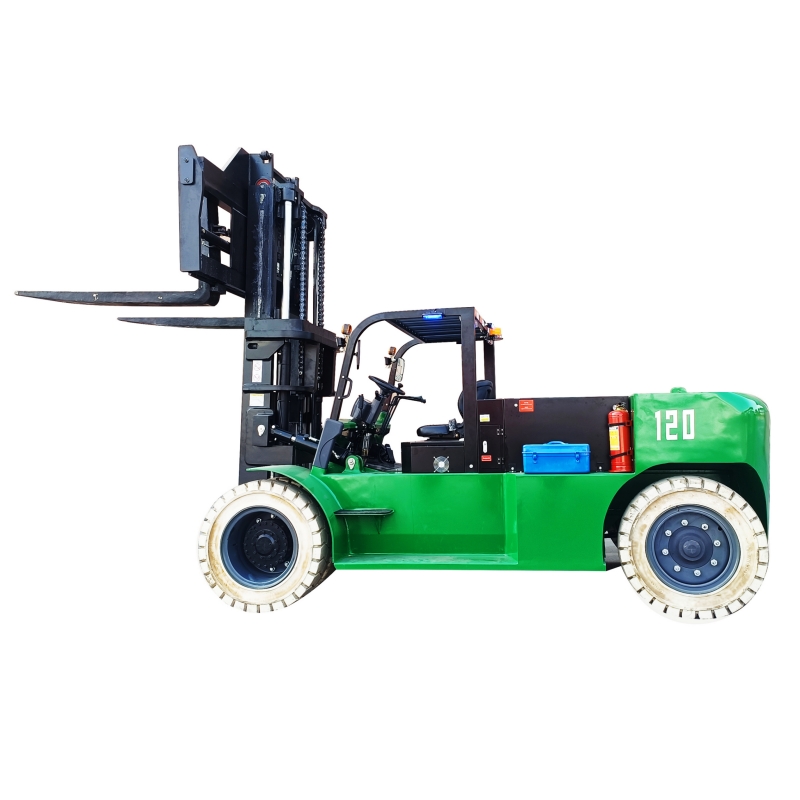
Large capacity electric counterbalance forklift for industrial lifting operations
What Is a Large Capacity Electric Forklift?
A large capacity electric forklift is a battery-powered industrial truck designed to lift, transport, and stack heavy loads. Unlike standard warehouse forklifts, which commonly handle loads of around 1–5 tons, heavy-duty electric counterbalance forklifts can be configured for significantly higher capacities.
For example, NEOlift offers heavy-duty electric counterbalance forklift configurations in the following capacity ranges:
Forklift category
Rated capacity range
Published lifting height range
Heavy-duty electric counterbalance forklift
6–12 tons
3–8 m
Large electric heavy-duty forklift
13–20 tons
3–8 m
Extra-large electric counterbalance forklift
25–35 tons
3–8 m
These ranges provide a starting point for equipment selection. The actual rated capacity of a specific machine must be confirmed from its technical specification and load chart, including the mast, attachment, load center, and lifting height.
For operations requiring a heavy-duty battery-powered forklift, buyers can review the electric heavy-duty forklift range to compare available capacity options and configurations.
Start with the Actual Weight and Dimensions of the Load
The first step in choosing a large capacity electric forklift is to identify the heaviest load the machine will handle during normal operation. Do not use the average cargo weight as the selection standard. The forklift should be evaluated against the heaviest expected load and the most demanding handling condition.
Weight alone is not enough. Load dimensions and the position of the center of gravity also affect forklift capacity. A compact steel block and a long industrial component may have the same weight but create very different lifting conditions.
Before requesting a quotation, prepare the following load information:
Maximum load weight, including packaging and any supporting frame.
Load length, width, and height.
Horizontal distance from the fork face to the load center of gravity.
Whether the load is evenly distributed or concentrated on one side.
Whether the cargo is fragile, irregular, cylindrical, or difficult to secure.
Required fork length, fork spacing, and any special attachment.
For example, a 10-ton load with a standard load center may be suitable for one forklift configuration, while a longer 10-ton load with its center of gravity farther forward may require a higher-capacity truck. The increased load moment can reduce the forklift's allowable lifting capacity.
When handling long or oversized materials, the load should be assessed as a complete package rather than simply using its weight. This is particularly important in steel processing, machinery manufacturing, and heavy industrial logistics.
Check Rated Capacity at the Required Lifting Height
Rated capacity is one of the most important specifications when buying a heavy-duty electric forklift. However, the rated figure usually applies to a defined load center and a specific truck configuration. It does not mean the forklift can lift the same maximum weight at every height.
As the mast rises, the load's position and the forklift's stability conditions change. Attachments can also add weight and move the load center farther forward. These factors may reduce the allowable capacity.
For this reason, buyers should request a manufacturer-approved residual capacity chart that covers the actual operating configuration.
Consider a purchasing example: a factory needs to lift an 8-ton machine component to a rack or loading platform at a height of 6 meters. A forklift advertised with a 10-ton rated capacity should not automatically be accepted. The buyer must confirm that the machine can safely lift at least 8 tons at the required height and load center with the selected mast and attachment.
The capacity chart should reflect:
Rated load and actual load center.
Maximum lifting height.
Mast type and mast configuration.
Attachment weight and forward load displacement.
Any manufacturer-specified operating restrictions.
Always compare the required load against the approved capacity at the actual lifting position. A higher nominal tonnage does not replace a configuration-specific load chart.
Forklift mast and fork configuration should match the load center and required lifting height
Choose the Appropriate Tonnage for Your Operation
Large capacity electric forklifts are available in different tonnage classes because industrial applications do not all have the same load requirements. Selecting a suitable capacity range helps balance lifting performance, machine size, energy consumption, and investment cost.
Six to Twelve Ton Electric Forklifts
This range is suitable for factories and industrial facilities handling heavy components, machinery parts, metal products, and large palletized materials.
NEOlift's 6–12 ton heavy-duty electric counterbalance forklift range offers a lifting height of 3–8 meters. The product uses a lithium battery configuration and a coordinated motor control system designed to match power output with operating demand. The product range also supports customized solutions for different working conditions.
For example, the NPS120 specification listed on the product page has a rated capacity of 12,000 kg and a 600 mm load center. Buyers should use the complete specification and approved load chart when evaluating this model for a particular application.
View the 6–12 ton heavy-duty electric counterbalance forklift for more product details.
Thirteen to Twenty Ton Electric Forklifts
For heavier industrial loads, a 13–20 ton electric forklift may be a better option. Typical applications include large metal components, heavy machinery, industrial molds, and materials handled in logistics yards.
NEOlift's 13–20 ton heavy-duty electric forklift uses a high-voltage lithium battery solution and a coordinated control system. The published lifting height range is 3–8 meters. Its energy management features include automatic idle shutdown and regenerative energy recovery under suitable operating conditions.
These features are relevant for facilities that need substantial lifting capacity but also want to manage energy use during repeated handling cycles.
See the 13–20 ton heavy-duty electric forklift with lithium battery for its configuration and technical information.
Twenty-Five to Thirty-Five Ton Electric Forklifts
When handling extremely heavy materials, buyers may need an extra-large electric counterbalance forklift. This category is designed for demanding applications such as port operations, heavy manufacturing, industrial equipment handling, and large-scale logistics.
NEOlift's 25–35 ton large capacity electric counterbalance forklift has a published lifting height range of 3–8 meters. Its NPS300 configuration lists a rated capacity of 30,000 kg and a load center of 1,250 mm. The product also uses a 580V–612V high-voltage electrical system and a battery-powered drive configuration.
For buyers handling very heavy individual loads, this range offers a starting point for evaluating the required lifting capacity, machine dimensions, operating environment, and battery system.
Explore the 25–35 ton large capacity electric counterbalance forklift for the published product specifications.
Evaluate Battery Capacity and Operating Hours
Battery performance directly affects the productivity of a large capacity electric forklift. Heavy-duty lifting requires energy not only for driving but also for repeated mast lifting, hydraulic operation, steering, and auxiliary functions.
A forklift that can lift the required load but cannot complete the expected working shift without excessive charging interruptions may not be suitable for the operation.
When selecting the battery system, consider the following factors:
Daily working hours: Determine whether the forklift operates for one shift, two shifts, or continuous multi-shift production.
Operating intensity: Frequent lifting, traveling, and acceleration generally require more energy than occasional material handling.
Battery capacity: Confirm the battery voltage and rated capacity in Ah or kWh against the expected duty cycle.
Charging arrangements: Check available charging time, charger output, charging location, and electrical supply.
Temperature conditions: Cold storage and outdoor winter operation can affect battery performance and may require a suitable battery heating configuration.
Battery management: Review battery monitoring, temperature protection, overcurrent protection, and charging controls.
Lithium batteries are often considered for heavy-duty electric forklifts because they support opportunity charging and can provide high power output. However, the correct battery capacity depends on the actual operating schedule, not just the forklift's rated lifting capacity.
Ask the manufacturer to estimate operating time under your expected load and duty cycle. A useful battery proposal should include the battery voltage, rated capacity, expected runtime, charger specification, and charging recommendations.
Pay Attention to Motor and Hydraulic Performance
Heavy-duty lifting places substantial demands on both the forklift's electric drive system and hydraulic system. A high-capacity forklift needs more than a powerful battery. Its motors, controller, hydraulic pump, and control logic must work together to deliver stable lifting and traveling performance.
Several technical features deserve attention during product evaluation.
Drive Motor and Control System
The drive motor affects acceleration, travel speed, and the ability to move heavy loads across the worksite. The controller manages motor output according to operating demand. Coordinated control can help balance performance and energy consumption during repeated lifting and travel cycles.
Hydraulic Lifting System
The hydraulic system controls mast lifting, lowering, and other hydraulic functions. For heavy loads, smooth and predictable hydraulic response is important for accurate positioning and safe handling.
Ask about hydraulic pump capacity, lifting speed under load, pressure control, and the system's suitability for extended operation. The specifications should be evaluated against the actual lifting duty rather than an unloaded demonstration.
Energy Recovery and Thermal Management
Some heavy-duty electric forklifts use regenerative systems to recover energy during braking or load lowering. The recovered energy can be returned to the battery under suitable operating conditions.
Thermal management is also important. High-capacity motors, controllers, batteries, and hydraulic components generate heat during demanding work. Confirm the manufacturer's cooling arrangement and operating limits for the expected duty cycle.
Heavy-duty electric forklift designed for demanding industrial lifting tasks
Check Forklift Stability, Tires, and Working Surface
Stability is essential when lifting heavy materials. A forklift must remain within its approved operating limits while traveling, turning, lifting, and placing loads. The counterweight, wheelbase, mast, tire configuration, and chassis design all contribute to overall stability.
Before choosing a large capacity electric forklift, assess the working environment carefully.
Floor load capacity: Confirm that the floor can support the forklift's service weight together with the transported load.
Ground condition: Check whether the forklift will operate on smooth concrete, uneven outdoor surfaces, ramps, or industrial yard pavement.
Tire type: Select tires appropriate for the floor material, traction requirements, and operating environment.
Turning space: Check aisle width, turning radius, doorway clearance, and access to loading areas.
Visibility: Consider mast design, operator seating, mirrors, cameras, and other visibility features.
Load handling: Confirm that the load can be secured and positioned without exceeding the approved capacity.
A heavy-duty forklift may have a substantial service weight even before carrying a load. For indoor applications, check the building's floor loading limits and any restrictions on ramps, mezzanines, or elevated platforms.
Never use a forklift on a slope or uneven surface beyond the manufacturer's specified operating limits. Operators should follow the approved load chart, travel with the load in the recommended position, and avoid sudden turning or braking with elevated loads.
Match the Forklift to Your Industry Application
The best large capacity electric forklift depends on the materials being handled and the working conditions. A machine used in a steel plant may need different forks and load handling arrangements from one operating in a machinery factory or logistics yard.
Industry
Typical materials
Important selection factors
Steel and metal processing
Steel plates, metal billets, heavy components
Load center, fork dimensions, capacity chart, floor strength
Machinery manufacturing
Machine bases, molds, industrial equipment
Precise positioning, lifting height, special attachments
Ports and logistics yards
Heavy cargo, large industrial packages
Duty cycle, travel performance, outdoor conditions
Construction materials
Concrete products, structural components
Tire selection, ground conditions, load dimensions
Heavy industrial warehousing
Palletized machinery parts, heavy inventory
Aisle width, lifting height, battery runtime
For long materials such as steel profiles, pipes, and timber, a conventional counterbalance forklift may not always be the most efficient choice. An electric multi-directional forklift can move long loads sideways and reduce the aisle space needed for handling. The appropriate truck depends on the load length, weight, and warehouse layout.
For other heavy cargo that needs to be transported over longer distances rather than lifted and stacked, an electric heavy-duty material handling solution may be more appropriate than a conventional forklift.
Consider Customization for Special Heavy Loads
Standard forklift configurations may not cover every industrial handling requirement. Some loads are too long, too wide, unusually shaped, or difficult to secure using standard forks. Others require a specific lifting height, operating width, battery arrangement, or special attachment.
Customization may involve:
Customized fork length, spacing, and load handling attachments.
Special mast height and lifting configuration.
Battery capacity and charging system adjustments.
Cabin configuration and operator visibility improvements.
Special tire and chassis arrangements for site conditions.
Additional cameras, warning systems, and safety features.
However, customization should not be treated as a way to bypass the forklift's rated capacity or stability limits. Any change to the mast, attachment, fork dimensions, or load center must be reviewed by the manufacturer. The final approved configuration should have a corresponding capacity rating and updated data plate.
NEOlift provides customized material handling equipment and heavy-duty forklift solutions for different industrial requirements. Buyers can submit their cargo dimensions, working conditions, and handling process through the Bespoke Forklifts contact page to discuss a suitable configuration.
Compare Total Cost of Ownership, Not Only Purchase Price
A large capacity electric forklift is a significant equipment investment. Comparing only the initial purchase price may overlook important costs during years of operation.
When evaluating different suppliers, consider the total cost of ownership, including:
Purchase price: Compare the complete machine configuration, including battery, charger, mast, and attachments.
Electricity cost: Estimate energy consumption using the expected working hours and local electricity price.
Battery replacement: Review battery warranty, expected service life, and replacement cost.
Maintenance: Consider service intervals, hydraulic components, tires, brakes, and electrical system maintenance.
Downtime: Evaluate spare parts availability and the supplier's technical support arrangements.
Operator productivity: Consider lifting speed, travel performance, charging time, and suitability for the work cycle.
Electric forklifts can offer lower routine maintenance requirements because they do not use conventional internal combustion engines. However, battery condition, controller performance, hydraulic components, and charging practices still require regular inspection.
Ask suppliers to provide a clear specification and a realistic operating cost estimate based on your actual application. This makes it easier to compare equipment on a like-for-like basis.
Why Consider NEOlift for Large Capacity Electric Forklifts?
Choosing a heavy-duty forklift manufacturer involves more than finding a product with the required tonnage. The supplier should understand the relationship between load weight, load center, lifting height, battery performance, and the operating environment.
NEOlift, operated by Shanghai Zon-Cho Huge Science and Technology Co., Ltd., supplies electric forklifts and customized material handling equipment for industrial applications. Its product range includes 6–12 ton, 13–20 ton, and 25–35 ton heavy-duty electric counterbalance forklift configurations.
The product range includes lithium battery solutions, coordinated motor control, hydraulic system optimization, and energy management features. Customized configurations can also be discussed for applications that require special load handling or operating conditions.
When requesting a proposal, provide the supplier with the following information:
Maximum cargo weight and dimensions.
Load center and center of gravity.
Required lifting height and working aisle width.
Daily operating hours and expected duty cycle.
Indoor or outdoor working conditions.
Floor type, slope, and ground conditions.
Battery runtime and charging requirements.
Any special forks, attachments, or safety options.
With these details, the manufacturer can evaluate whether a standard model is suitable or whether a customized heavy-duty electric forklift is required. The final proposal should include the technical specification, rated capacity chart, battery details, and approved operating configuration.
Final Checklist Before Buying a Large Capacity Electric Forklift
Before placing an order, make sure the selected forklift meets the actual handling requirements rather than relying on its advertised maximum tonnage alone.
Confirm the maximum cargo weight and load dimensions.
Verify the rated capacity at the actual load center and lifting height.
Check the mast, forks, attachments, and residual capacity chart.
Evaluate battery voltage, capacity, runtime, and charging arrangements.
Review motor, controller, hydraulic, and thermal management specifications.
Confirm floor strength, tire type, turning space, and operating environment.
Check safety features, visibility, and operator requirements.
Compare warranty coverage, spare parts, and after-sales support.
The right large capacity electric forklift is the one that safely handles the heaviest expected load at the required height, completes the planned working cycle, and fits the site's physical and operational conditions. By checking these factors before purchase, industrial buyers can choose equipment that delivers dependable lifting performance and long-term operating value.
Frequently Asked Questions About Large Capacity Electric Forklifts
What is considered a large capacity electric forklift?
A large capacity electric forklift is a battery-powered forklift designed for heavy industrial loads beyond the capacity of standard warehouse trucks. Heavy-duty models are available in different ranges, including 6–12 tons, 13–20 tons, and 25–35 tons, depending on the manufacturer and configuration.
How much weight can a heavy-duty electric forklift lift?
Heavy-duty electric forklift capacity depends on the model. NEOlift offers product ranges from 6 tons to 35 tons. The actual allowable load must be verified against the machine's rated capacity chart, load center, mast configuration, attachment, and lifting height.
What is the difference between a 12 ton and a 20 ton electric forklift?
A 12 ton forklift is designed for loads within its approved capacity range, while a 20 ton forklift is intended for heavier applications. The larger model generally has a different chassis, battery, motor, hydraulic, and structural configuration. The correct choice depends on the maximum load and working conditions rather than tonnage alone.
Can a large capacity electric forklift lift its full rated load at maximum height?
Not necessarily. The rated capacity is based on a defined load center and configuration. Allowable capacity can decrease when the load center moves forward, lifting height increases, or an attachment changes the load position. Always check the manufacturer's approved residual capacity chart.
Are lithium batteries suitable for heavy-duty electric forklifts?
Yes. Lithium battery systems are used in heavy-duty electric forklifts because they can support high-power operation and opportunity charging. Battery voltage, capacity, charging equipment, temperature protection, and expected operating hours should be checked for the specific application.
How long can a large capacity electric forklift operate on one charge?
Operating time depends on battery capacity, load weight, lifting frequency, travel distance, working hours, and environmental temperature. Ask the manufacturer for an estimated runtime based on your actual duty cycle instead of relying on a general operating-hour figure.
What industries use large capacity electric forklifts?
Large capacity electric forklifts are used in steel processing, machinery manufacturing, ports, industrial warehousing, construction material handling, and logistics facilities. The required capacity and configuration depend on the materials and working environment.
Can a large capacity electric forklift be customized?
Yes. Depending on the manufacturer and model, customization may include fork dimensions, attachments, mast height, battery configuration, cabin design, tires, and safety equipment. Any modification affecting capacity or stability must be approved by the manufacturer and reflected in the final rated capacity documentation.
What should I provide when requesting a heavy-duty electric forklift quotation?
Provide the maximum load weight, load dimensions, center of gravity, required lifting height, daily operating hours, floor conditions, working environment, and battery runtime requirements. Include details of any special attachments or handling procedures so the supplier can recommend an appropriate configuration.
Does NEOlift offer large capacity electric counterbalance forklifts?
Yes. NEOlift's published product range includes 6–12 ton, 13–20 ton, and 25–35 ton heavy-duty electric counterbalance forklift configurations. Buyers can contact the company with their load and site requirements to discuss a suitable model or customized solution.
For a large capacity electric forklift recommendation, contact our technical sales team with your load details and operating requirements.
{
"@context": "https://schema.org",
"@type": "FAQPage",
"mainEntity": [
{
"@type": "Question",
"name": "What is considered a large capacity electric forklift?",
"acceptedAnswer": {
"@type": "Answer",
"text": "A large capacity electric forklift is a battery-powered forklift designed for heavy industrial loads beyond the capacity of standard warehouse trucks. Heavy-duty models are available in different ranges, including 6–12 tons, 13–20 tons, and 25–35 tons, depending on the manufacturer and configuration."
}
},
{
"@type": "Question",
"name": "How much weight can a heavy-duty electric forklift lift?",
"acceptedAnswer": {
"@type": "Answer",
"text": "Heavy-duty electric forklift capacity depends on the model. NEOlift offers product ranges from 6 tons to 35 tons. The actual allowable load must be verified against the machine's rated capacity chart, load center, mast configuration, attachment, and lifting height."
}
},
{
"@type": "Question",
"name": "What is the difference between a 12 ton and a 20 ton electric forklift?",
"acceptedAnswer": {
"@type": "Answer",
"text": "A 12 ton forklift is designed for loads within its approved capacity range, while a 20 ton forklift is intended for heavier applications. The larger model generally has a different chassis, battery, motor, hydraulic, and structural configuration. The correct choice depends on the maximum load and working conditions rather than tonnage alone."
}
},
{
"@type": "Question",
"name": "Can a large capacity electric forklift lift its full rated load at maximum height?",
"acceptedAnswer": {
"@type": "Answer",
"text": "Not necessarily. The rated capacity is based on a defined load center and configuration. Allowable capacity can decrease when the load center moves forward, lifting height increases, or an attachment changes the load position. Always check the manufacturer's approved residual capacity chart."
}
},
{
"@type": "Question",
"name": "Are lithium batteries suitable for heavy-duty electric forklifts?",
"acceptedAnswer": {
"@type": "Answer",
"text": "Yes. Lithium battery systems are used in heavy-duty electric forklifts because they can support high-power operation and opportunity charging. Battery voltage, capacity, charging equipment, temperature protection, and expected operating hours should be checked for the specific application."
}
},
{
"@type": "Question",
"name": "How long can a large capacity electric forklift operate on one charge?",
"acceptedAnswer": {
"@type": "Answer",
"text": "Operating time depends on battery capacity, load weight, lifting frequency, travel distance, working hours, and environmental temperature. Ask the manufacturer for an estimated runtime based on your actual duty cycle instead of relying on a general operating-hour figure."
}
},
{
"@type": "Question",
"name": "What industries use large capacity electric forklifts?",
"acceptedAnswer": {
"@type": "Answer",
"text": "Large capacity electric forklifts are used in steel processing, machinery manufacturing, ports, industrial warehousing, construction material handling, and logistics facilities. The required capacity and configuration depend on the materials and working environment."
}
},
{
"@type": "Question",
"name": "Can a large capacity electric forklift be customized?",
"acceptedAnswer": {
"@type": "Answer",
"text": "Yes. Depending on the manufacturer and model, customization may include fork dimensions, attachments, mast height, battery configuration, cabin design, tires, and safety equipment. Any modification affecting capacity or stability must be approved by the manufacturer and reflected in the final rated capacity documentation."
}
},
{
"@type": "Question",
"name": "What should I provide when requesting a heavy-duty electric forklift quotation?",
"acceptedAnswer": {
"@type": "Answer",
"text": "Provide the maximum load weight, load dimensions, center of gravity, required lifting height, daily operating hours, floor conditions, working environment, and battery runtime requirements. Include details of any special attachments or handling procedures so the supplier can recommend an appropriate configuration."
}
},
{
"@type": "Question",
"name": "Does NEOlift offer large capacity electric counterbalance forklifts?",
"acceptedAnswer": {
"@type": "Answer",
"text": "Yes. NEOlift's published product range includes 6–12 ton, 13–20 ton, and 25–35 ton heavy-duty electric counterbalance forklift configurations. Buyers can contact the company with their load and site requirements to discuss a suitable model or customized solution."
}
}
]
}