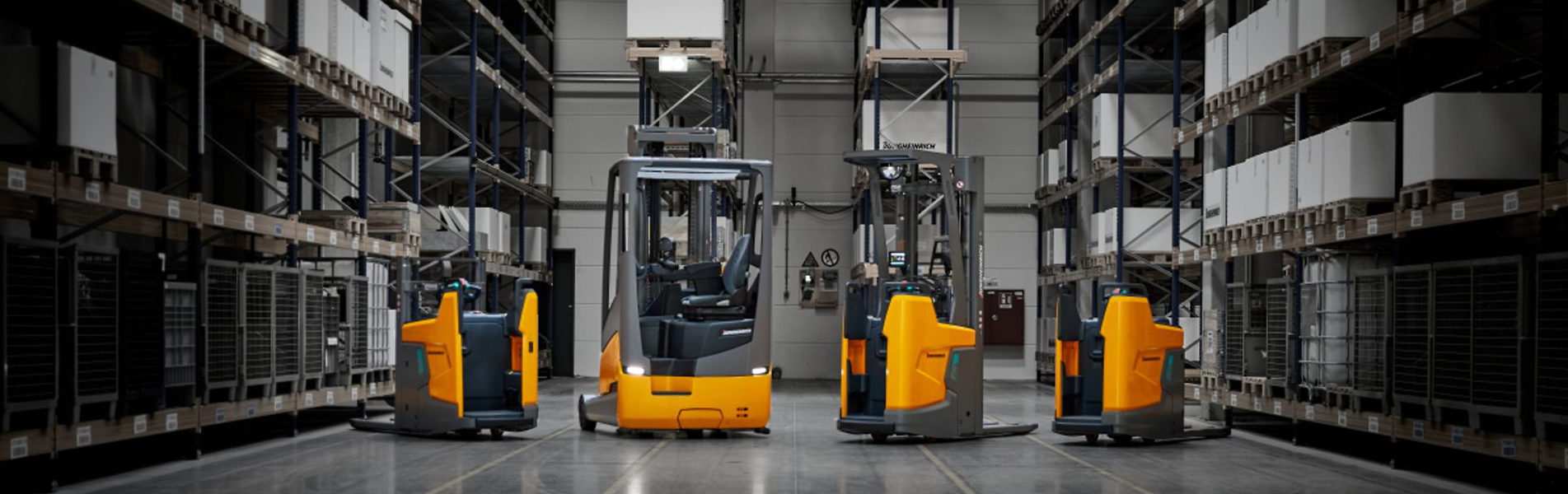
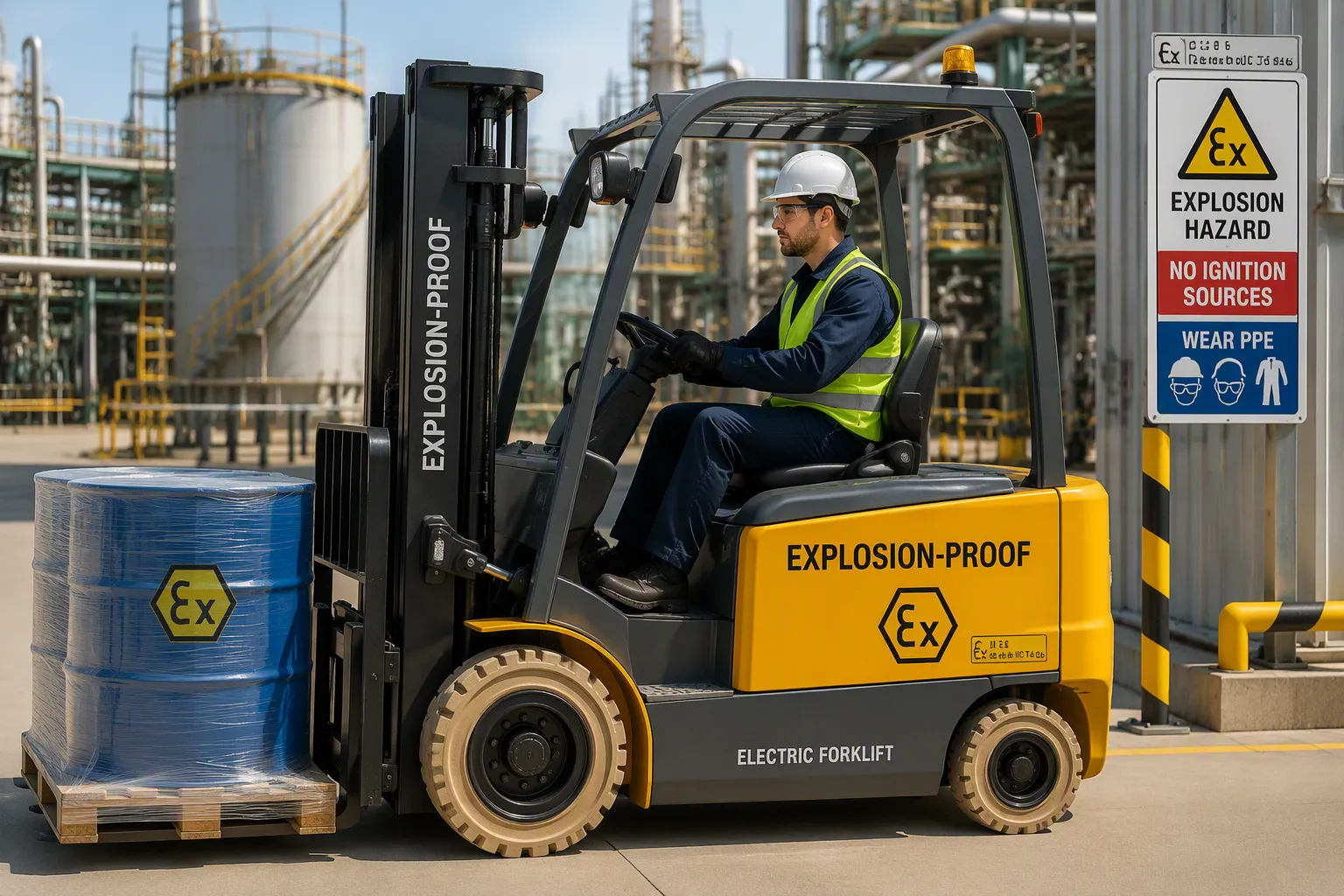
You start by matching the certification of an explosion proof electric forklift to your hazardous area classification. The unit must suit your specific zone, gas group, and temperature class. A wrong choice creates ignition risk. Over-specifying raises cost without added safety.
Match the forklift's certification to your hazardous area's zone, gas group, and temperature class to prevent ignition risks.
Verify all certification markings on the forklift's nameplate and ensure they align with your area classification document.
Assess your application needs like shift patterns, floor conditions, and aisle width to ensure the forklift fits your operation.
Your facility's area classification document defines the risk. You must read it before you compare any explosion proof electric forklift models.
ATEX is an EU directive that regulates equipment for explosive atmospheres. It uses three zones: Zone 0, 1, and 2. The NEC in the United States uses a Class and Division structure under Articles 500-504. Class I covers flammable gases. Division 1 covers continuous or intermittent presence. Division 2 covers abnormal conditions only.
|
Feature |
ATEX/IECEx Zone System |
NEC Division System |
|---|---|---|
|
Risk granularity |
Three levels: Zone 0, 1, 2 |
Two levels: Division 1, 2 |
|
Basis of classification |
Probability and duration of explosive atmosphere |
Likelihood under normal vs. abnormal conditions |
|
Equipment markings |
Zone, gas group, temperature class |
Class, Division, Group, temperature class |
NEC Article 505 bridges the two systems. It lets you use ATEX/IECEx-certified equipment in US Zone 1 locations when the AHJ accepts the certification.
Gas groups classify flammable vapors by their ignition behavior. Dust groups do the same for combustible dusts. Your classification document lists the specific group for your area. The forklift's certification must match that group exactly.
The temperature class sets the maximum surface temperature the equipment can reach. A T4 rating means 135°C. A T6 rating means 85°C. You match the class to the ignition temperature of your substance.
|
Temperature Class |
Maximum Surface Temperature |
|---|---|
|
T1 |
450°C |
|
T2 |
300°C |
|
T3 |
200°C |
|
T4 |
135°C |
|
T5 |
100°C |
|
T6 |
85°C |
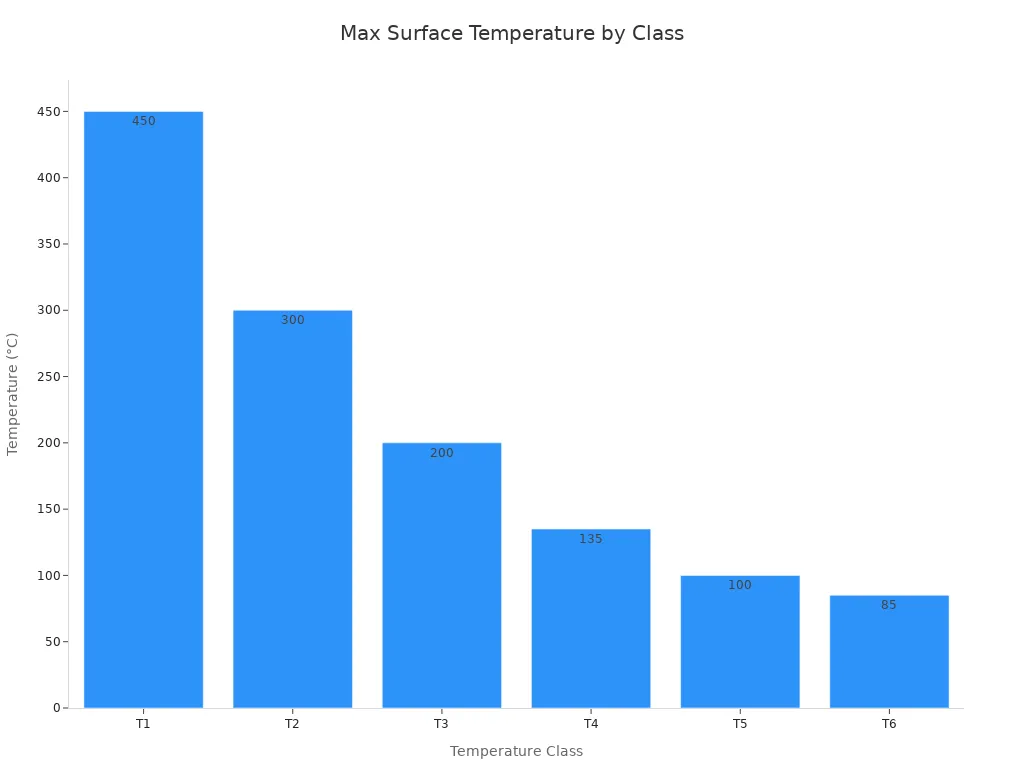
Under IEC 60079-31, Zone 22 equipment must not exceed T4 (135°C). For self-heating dust layers, certification may reduce this limit to T5 (100°C). Zone 22 stackers therefore typically fall within the T4 or T5 range.
Your document lists the zone, gas or dust group, and temperature class for each area. You check these three values against the forklift's certification label. A mismatch means the unit is not safe for that location.
Your area classification document gives you three values: zone, group, and temperature class. Now you turn those values into a specification. Every marking on the forklift's nameplate must line up with those three values. This section walks you through each specification category you need to verify.
Certification markings tell you exactly where a forklift can operate. You cannot rely on a sales brochure or a verbal assurance. You read the nameplate.
Three major certification frameworks govern explosion proof electric forklift design worldwide. Each one uses its own language and its own logic.
|
Certification |
Region |
Description |
|---|---|---|
|
ATEX |
European Union |
Ensures equipment is safe for explosive atmospheres, categorized by risk zones. |
|
IECEx |
International |
Global standard verifying equipment's safety in explosive environments. |
|
NEC |
North America |
Defines hazardous location classifications for industrial equipment. |
The NEC philosophy aims to contain explosions. The IEC philosophy focuses on preventing and containing them. US standards applicable to EX forklift electrical design include UL 1203, UL 1604, UL 583, NFPA 505, OSHA 1910.178, and ANSI. EX forklifts must be tested and certified for Class 1, Division 1, Groups C&D in accordance with NEC, UL 1203, and UL 583. International standards build on the European ATEX directives, and ongoing efforts continue to harmonize US codes into the international framework.
UL 583 requires specific markings on every EX truck. You verify each one before you accept delivery.
Type designation on each side in a prominent location, with a 5-inch width, yellow background, and black letters.
Class and Group of hazardous location(s) for which the truck is approved (e.g., Class I, Division 1 & 2, Group D; Class II, Division 1 & 2, Group G).
Maximum external operating temperature or operating temperature class (T-Code).
A statement calling attention to the necessity for keeping enclosures of electrical parts and wiring tightly assembled while in hazardous areas.
Name or trademark of the manufacturer, catalog designation, normal voltage rating of the battery, truck gradeability, and a schematic or pictorial circuit-wiring diagram.
An ATEX marking like Ex II 2G Ex de IIB T4 Gb packs seven pieces of information into one string. You decode each piece to confirm suitability.
Ex – Indicates the equipment is certified as explosion-protected and complies with ATEX/IECEx standards.
II – Equipment Group II: intended for use in all places other than mines susceptible to firedamp (i.e., surface industries with potentially explosive atmospheres).
2G – Category 2G: equipment suitable for Zone 1 (gas) hazardous areas, where an explosive gas atmosphere is likely to occur during normal operation. Category 2 provides a high level of protection.
Ex de – Protection concepts: 'd' = flameproof enclosure (contains internal explosion and prevents flame propagation to the surrounding atmosphere); 'e' = increased safety (additional measures to prevent excessive temperatures and sparking/arcing).
IIB – Gas group IIB: equipment is suitable for atmospheres containing gases with ignition energies corresponding to group IIB (e.g., ethylene). This is a medium-level gas group; equipment marked IIB can also be used in IIA atmospheres but not in IIC (e.g., hydrogen, acetylene) unless specifically marked IIB+H2.
T4 – Temperature class T4: the maximum surface temperature of the equipment will not exceed 135°C, making it safe for gases with auto-ignition temperatures above 135°C.
Gb – Equipment Protection Level (EPL) Gb: high protection level for gas atmospheres, suitable for Zone 1 (and by extension Zone 2).
Real-world examples show how these markings map to specific truck models. An EXF 16 explosion-protected forklift truck with self-supporting ISO forks carries the marking Ex II 2G IIB+H2 T4, Gb. This confirms Group II, Category 2G (gas), suitable for Zone 1. EXG 12, EXG 03, and EXV 12 explosion-proof forklift trucks carry Ex II 2G IIB T4. A LiTex lithium battery for ATEX Zone 1/21 carries Ex II 2G IIB+H2 T4 for gas and Ex II 2D IIIB T135°C for dust. A pressurized LiTex charger carries both ratings. An EXR 14 reach truck holds ATEX Zone 1 (2G) and 21 (2D) approval.
Protection concepts vary by component and by zone. You match the concept to the zone where the component sits.
|
Protection Concept |
Full Name |
Standard |
Permitted Zones |
|---|---|---|---|
|
Ex d |
Flameproof Enclosure |
UL/CSA 60079-1 |
Zone 1 or Zone 2 |
|
Ex e |
Increased Safety |
UL/CSA 60079-7 |
Zone 1 or Zone 2 |
|
Ex i |
Intrinsic Safety |
UL/CSA 60079-11 |
Zone 0, Zone 1, or Zone 2 (and Zone 20, 21, 22 for equipment listed for dust) |
A flameproof enclosure contains an internal explosion and stops flame from escaping. Increased safety adds measures to prevent excessive temperatures and sparking. Intrinsic safety limits energy to a level too low to ignite the atmosphere. Each concept suits different components. You confirm that the manufacturer applied the right concept to each part of the truck.
The IP rating tells you how well the enclosure keeps out dust and water. A higher IP number means better sealing. You match the IP rating to your environment.
Dusty grain facilities need a high dust ingress rating. Washdown areas need a high water ingress rating. Chemical plants may need both. The IP rating appears on the nameplate alongside the explosion protection marking.
Sealing is not a one-time achievement. Batteries and electrical housings on EX trucks are sealed to contain internal sparks, but gaskets and seals degrade due to heat cycling and vibration. A truck that passed certification a year ago may no longer meet the standard today without regular inspection. Seal wear is rarely visible from the outside. Plants that rely only on visual casing inspections often miss the exact failure point that an incident investigation would identify.
Several design features protect the integrity of the sealing system. You verify each one during specification review and during maintenance.
Threaded wiring connections: All wiring entering EX enclosures must use threaded connections that thread deeper than typical threads, preventing loosening during operation that could make the connection unsafe or pull wiring out of the enclosure.
Conduit sealing: Wiring conduits must be sealed at each connecting enclosure using EX-rated sealing epoxy, preventing an explosion from traveling between enclosures through the conduit.
Threaded flame paths: Threaded paths require a minimum of five threads for NPT-type threads (varying for standard fastener threads) to keep fasteners secure and stop flame or spark propagation from the enclosure interior.
Flame path cleanliness and integrity: Flame paths and surfaces must be kept free of debris, scratches, and physical flaws. Any damage or debris can enlarge or alter the flame path beyond what UL 583 deems safe. Even a small piece of paper or dust on a lid flange can shim the lid off its mating surface enough to let a spark or flame escape.
Protective handling during service: Surfaces should be taped off to protect against scratches, dust, debris, or physical damage, then wiped with a mild cleaning solution before installation.
You build these checks into your maintenance schedule. A sealing system that degrades without detection defeats the purpose of the certification.
The battery and motor are the largest energy sources on an electric forklift. They demand the most attention during specification.
Battery technology affects your charging infrastructure and your safety procedures. Lead-acid electric forklifts became common indoors because they avoid exhaust. However, charging can release hydrogen. Therefore, many sites need a controlled charging room, ventilation, gas monitoring, and strict operating rules.
Lead-acid electric forklifts became common indoors. They avoid exhaust. However, charging can release hydrogen. Therefore, many sites need a controlled charging room, ventilation, gas monitoring, and strict operating rules.
Lithium-ion batteries offer an alternative for Zone 1 and Zone 21 environments. A LiFePO4 lithium battery meets international explosion-proof certification standards and is designed for Class I, Div 1/2 and ATEX Zone 1/21 environments. Features include a flameproof enclosure, a smart battery management system, and IP54 sealing. The lithium battery is engineered to replace traditional lead-acid batteries in ATEX Zone 1/21 environments, which indicates that lead-acid was previously used and approved under those zone classifications.
|
Battery Technology |
Approval Evidence |
|---|---|
|
Lead-Acid |
Implicitly approved – the lithium battery is engineered to replace traditional lead-acid batteries in ATEX Zone 1/21 environments, indicating lead-acid was previously used and approved under those zone classifications. |
|
Lithium-Ion (LiFePO4) |
Explicitly approved – meets international explosion-proof certification standards and is designed for Class I, Div 1/2 and ATEX Zone 1/21 environments. Features include flameproof enclosure, smart BMS, and IP54 sealing. |
The motor must carry its own explosion protection rating. You check that the motor's marking matches the zone where the truck operates. The same rule applies to controllers, contactors, lights, horns, and every other electrical component on the truck.
Wiring between components must follow the protection concept for each zone. Intrinsically safe circuits require barriers and specific cable types. Flameproof circuits require sealed conduit and threaded entries. You confirm that the manufacturer documented the protection concept for every circuit.
Explosion protection adds weight and changes the truck's center of gravity. You cannot assume that a standard forklift's load chart applies to an EX version.
The data plate on the EX truck states the rated capacity at a given load center. You compare that rating to your heaviest load and your actual load center. A longer load shifts the center of gravity forward and reduces the safe capacity. You check the derated capacity, not the nominal capacity.
Lift height affects stability. A high lift with a heavy load demands a larger counterweight and a wider stance. Explosion-proof components may limit the available counterweight space. You verify the truck's capacity at your maximum lift height, not just at ground level.
Attachments change the load geometry. A clamp, a rotator, or a side shifter moves the load center and adds weight. You confirm that the attachment carries its own explosion protection rating if it operates in the hazardous area. Forks made from spark-resistant materials, such as bronze alloys, reduce ignition risk from impact. You verify that the attachment manufacturer certified the attachment for your zone, group, and temperature class.
You also check the aisle width and turning radius. An EX truck may have a larger footprint than a standard model because of added enclosures and sealing. You measure your narrowest aisle and compare it to the truck's right-angle stacking dimension. A truck that cannot maneuver safely in your space creates a different kind of hazard.
Start by mapping shift patterns and duty cycles. An explosion proof electric forklift must handle peak demand without overheating. Continuous multi-shift operation requires a larger battery or a spare rotation plan. Intermittent use permits a smaller battery.
Charging areas deserve equal attention. Charging releases hydrogen gas. You must ventilate the area adequately under OSHA's 29 CFR 1910.178. Keep hydrogen below 1% concentration. Install spark-proof exhaust fans at the highest point. Place fresh-air louvers near the floor. Use hydrogen detectors that trigger audible and visual alarms and auto-activate exhaust fans.
Adequate ventilation must be provided for battery charging areas to disperse hydrogen gas under 29 CFR 1910.178. If hydrogen is detected, workers must stop charging, ventilate the area, and evacuate if necessary.
Maintain ventilation with six to ten air changes per hour. Prohibit smoking and ignition sources within 20 feet of charging equipment. Check ventilation performance regularly.
Your environment sets several specifications. Dusty facilities need high ingress protection. Washdown areas demand watertight enclosures. Chemical plants may need both.
Floor conditions affect stability. Uneven floors reduce capacity and raise tipping risk. Measure your narrowest aisle against the truck's right-angle stacking dimension. A wider EX truck cannot maneuver in tight spaces.
Documentation proves compliance for your explosion proof electric forklift. Collect these items before delivery:
|
Documentation |
What to Verify |
|---|---|
|
Original certification |
ATEX or IECEx paperwork |
|
Protection concept |
Explosion protection method |
|
Zone suitability |
Rating for your zone |
|
Temperature class |
T-code matching your area |
|
Maintenance records |
Service dates and parts |
|
Audit records |
Compliance verification |
Follow a systematic approach:
Confirm zone, gas group, and temperature class.
Verify certification markings on the nameplate.
Check the IP rating.
Match battery and motor protection.
Compare derated load capacity at maximum lift height.
Measure aisle clearance.
Review the documentation folder.
Consult a qualified explosion protection specialist before purchase. They confirm compliance and prevent costly mistakes.
Select the explosion proof electric forklift whose certification matches your hazardous area classification. Verify the gas group, temperature class, ingress protection, and third-party approvals. Assess load, lift height, shift patterns, and environment to ensure operational fit.
Consult a qualified explosion protection specialist before purchase to confirm compliance and avoid costly mistakes.
Zone 1 requires equipment rated for likely explosive atmospheres during normal operation. Zone 2 covers abnormal conditions only. You match your forklift certification to your specific zone.
No. A standard electric forklift lacks explosion protection. Sparks from motors, wiring, or connectors can ignite flammable gases or dust. You need a certified explosion proof unit.
You inspect seals and flame paths regularly, typically after every 500 operating hours. Heat cycling and vibration degrade gaskets. Damaged flame paths let sparks escape. Schedule inspections based on your duty cycle.
Zon-Cho Huge location near you