banner
  • Solid or Pneumatic Tires: Which Setup Suits a 10-50 Ton Forklift?
    Solid or Pneumatic Tires: Which Setup Suits a 10-50 Ton Forklift? Oct 19, 2026
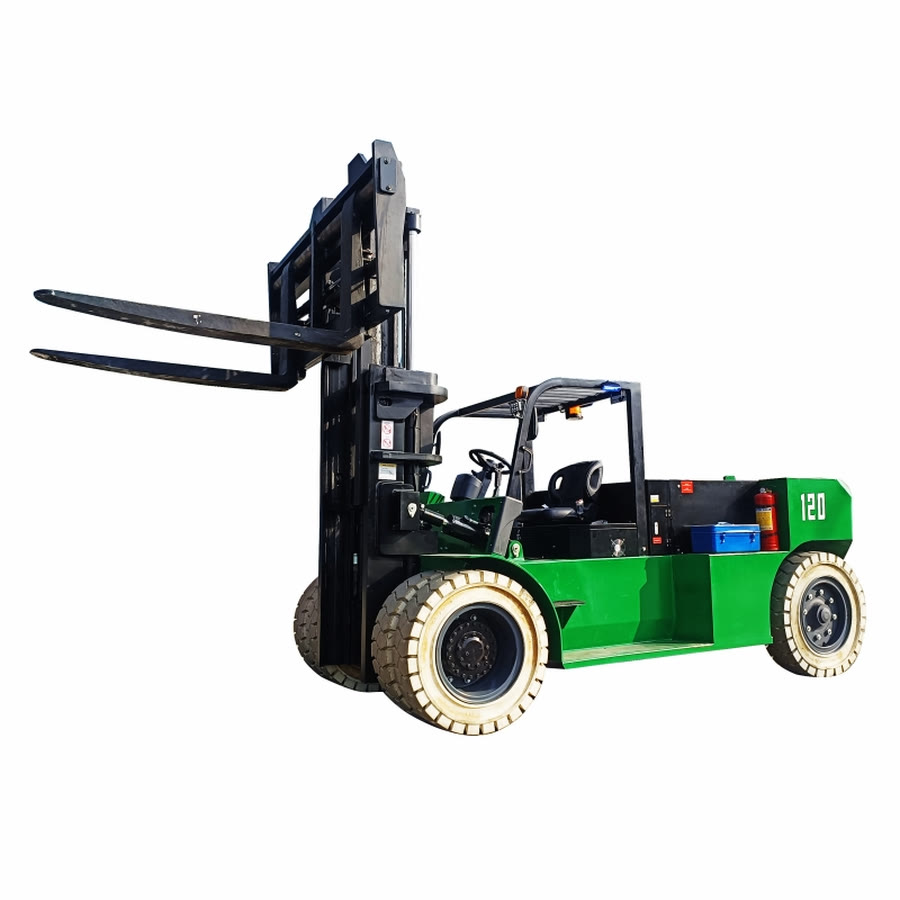
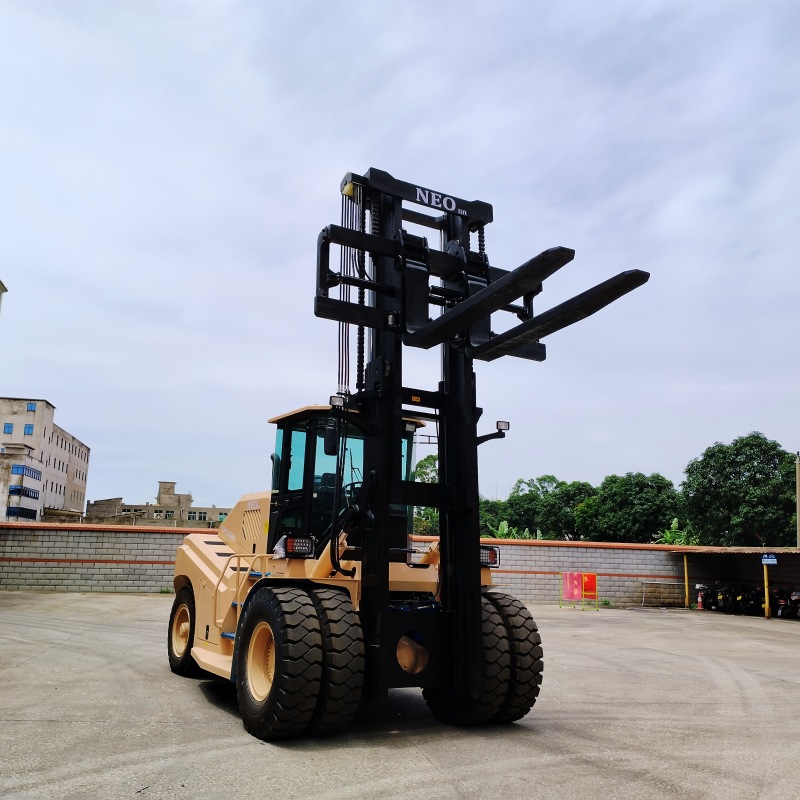
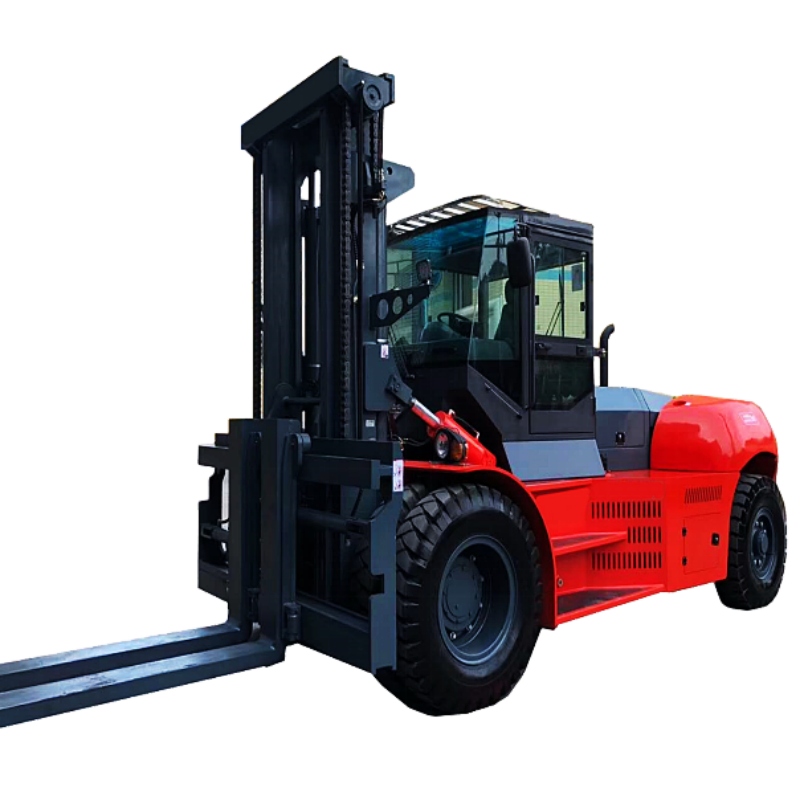
    Tire choice changes a heavy forklift's cost per hour more than most buyers expect. The wrong set turns a heavy duty electric forklift into a machine that eats rubber, damages concrete, or loses grip on wet steel plates. Solid pneumatic tires suit rough outdoor yards, ports and coil storage, where punctures from scrap and debris are routine. They carry rated loads at long load centers and shrug off gravel, mud and kerb impacts. The trade-off is a harsher ride and more drivetrain shock over long shifts. For yards that mix gravel with concrete aprons, Heavy-duty electric pneumatic tire forklifts are the usual compromise. A 12 ton heavy-duty forklift on solid pneumatic tires — the usual choice for gravel yards, ports and scrap handling. Pneumatic air-filled tires win on uneven ground and long travel distances — timber yards, sawmills, construction depots. They absorb vibration and protect the operator and mast, but need pressure checks and are exposed to sidewall cuts. They pair naturally with an Electric heavy-duty forklift truck working long outdoor routes, where operator comfort across an eight-hour shift matters as much as raw capacity. Solid resilient tires are the indoor answer: concrete floors, narrow aisles and multi-shift container handling. No punctures, tight turning and repeatable positioning for electric VNA forklift work and narrow-aisle truck travel. Fleet logic matters more than brochure specs. A 15 ton diesel forklift running 20 hours a day in a scrap yard is usually cheapest on solid pneumatic; a 30 ton electric forklift on polished coil-warehouse floors needs solid resilient to protect the slab and hold cycle times. In the 13-20 ton band, a 15 Ton Heavy-duty Electric Forklift Truck specified with the right compound can cover both a coil warehouse and an outdoor loading apron without changing wheels. A 16 ton unit specified on pneumatic tires — wheel configuration and compound are matched to the surface survey, not to capacity alone. NEO FORKLIFT matches tire compound, tread pattern and wheel configuration — dual tires, wide-base rims, non-marking options — to a surface survey before any 10-50 ton electric or diesel truck ships. Measure four things first: floor type, debris, ramp grade, and travel distance per shift. Those, not capacity alone, decide the tire. FAQ Do solid tires reduce lifting capacity? No. Capacity comes from mast, counterweight and load center. Tire type affects stability, ground pressure and ride. Can I switch from pneumatic to solid tires later? Often yes, but rims, mounting and axle load rating must match. Confirm with the manufacturer before ordering. How often should heavy forklift tires be inspected? Before every shift for cuts and embedded debris, weekly for wear depth and wheel-nut torque. Which tires suit a VNA warehouse? Solid resilient, non-marking where floors are coated — they hold the precise steering geometry narrow-aisle work depends on.
  • How to Choose a Cold Storage Electric Forklift for Your Freezer Warehouse
    How to Choose a Cold Storage Electric Forklift for Your Freezer Warehouse Oct 19, 2026
    Select a cold storage electric forklift by starting with the battery. Lithium-ion batteries deliver reliable sub-zero performance and lose minimal capacity in freezer environments. Confirm the hardware—hydraulics, seals, and lubrication—carries a factory rating for continuous freezer operation. Occasional cold exposure does not qualify. Match load capacity, lift height, and narrow-aisle turning radius to your warehouse stacking and throughput demands.   Key Takeaways Choose a lithium-ion battery for reliable power in freezing temperatures. Verify that the forklift has cold-rated seals, lubricants, and electrical protection. Implement safety measures like anti-skid tires and regular maintenance to prevent accidents.   Application Characteristics for a Cold Storage Electric Forklift Frequent Access and High Throughput in Freezer Zones Your freezer warehouse operates around the clock. Workers enter and exit freezer zones many times per shift. Each door opening releases cold air and pulls in warm, humid air. A cold storage electric forklift must handle this constant traffic without downtime. You need a machine that starts reliably at minus 20 degrees Fahrenheit or lower. High throughput demands fast acceleration, quick lifting speeds, and minimal battery charging interruptions. Choose a model with fast-charge capability and hot-swappable batteries. These features keep your operation moving through peak cycles.   High Stacking and Narrow Aisle Requirements Freezer warehouses maximize every cubic foot of space. You likely stack pallets five to eight levels high. Your aisles may measure only eight to ten feet wide. A cold storage electric forklift must deliver high lift heights without sacrificing stability. Look for a model with a tight turning radius and precise mast controls. Reach trucks and order pickers often suit these conditions better than standard counterbalance models. Confirm the forklift's residual capacity at your maximum lift height. Cold temperatures reduce hydraulic response, so you need extra margin on every lift. Managing Varying Temperature Zones Your facility likely includes multiple temperature zones. These zones range from ambient loading docks to blast freezers at minus 30 degrees Fahrenheit. A forklift may travel between these areas dozens of times per day. This movement creates thermal shock for the machine's components. You need a forklift rated for continuous transition between temperature extremes. Check the manufacturer's specifications for the acceptable temperature range. Verify that seals, lubricants, and electronics tolerate rapid temperature changes. A machine built only for steady cold operation may fail in your mixed-zone environment.   Essential Hardware Features for Cold Storage Electric Forklifts Battery Discharge Performance in Sub-Zero Conditions Battery performance defines your forklift's productivity in a freezer. Lithium-ion batteries outperform lead-acid alternatives in sub-zero conditions. A lithium-ion battery maintains 80 to 90 percent of its rated capacity at minus 20 degrees Fahrenheit. A lead-acid battery may lose 30 to 50 percent of its capacity at the same temperature. This difference directly affects your shift length and charging frequency. You need to evaluate the discharge curve, not just the nominal capacity. A battery with a flat discharge curve delivers consistent power throughout the shift. A battery with a steep curve loses voltage quickly under load. Cold temperatures accelerate voltage drop. Ask your supplier for discharge test data at your warehouse's lowest operating temperature. This data reveals the true runtime you can expect. Fast-charge capability matters in high-throughput freezer operations. Lithium-ion batteries accept fast charging without damage. You can opportunity-charge during breaks and shift changes. This approach eliminates the need for battery swapping and reduces your fleet size. Confirm the charger operates reliably in cold ambient conditions. Some chargers derate their output in freezing temperatures, which extends charge times.   Cold-Weather Adaptations for Buffers and Seals Cold temperatures attack every rubber and polymer component on your forklift. Standard seals become brittle and crack. Hydraulic hoses stiffen and leak. You need a cold storage electric forklift with factory-installed cold-weather adaptations. These adaptations include low-temperature seals, flexible hydraulic hoses, and cold-rated lubricants. Lubrication requires special attention. For cold storage forklift masts and chains, the lubricant must remain fluid at extremely low temperatures. A cold-rated chain lubricant with a low-temperature penetration rating below minus 20 degrees is specified to maintain flow characteristics and keep chain links lubricated in deep-freezer applications. Standard grease or chain lubricant that performs well at 70 degrees can become nearly solid at 0 degrees, preventing proper penetration between chain links and leaving pins and bushings inadequately lubricated. You should verify several lubrication points during your hardware evaluation: Freezer-rated forklifts use low-temperature grease for mast channels and load wheels because standard grease stiffens and stops distributing in cold conditions. Cold-rated hydraulic oil and low-temperature grease are specified for continuous duty down to roughly minus 30 degrees Celsius. Standard hydraulic oil thickens sharply as temperatures fall, which can slow lift speed and strain the pump, so low-viscosity hydraulic fluid is used instead. Electrical protection is equally critical. Condensation forms when your forklift moves between temperature zones. This moisture attacks controllers, sensors, and wiring harnesses. Cold storage forklifts are equipped with highly protected electronics featuring anti-condensation design. Controllers, sensors, and wiring harnesses carry high IP ratings such as IP54 or IP65, meaning they are sealed against moisture ingress. Critical components often include built-in heating elements to prevent internal moisture from freezing. For an industrial electric forklift to be considered waterproof, it must have sealed controllers and protected electrical junctions. Each wire harness is treated, and connectors are typically automotive-grade sealed units. Most outdoor-capable electric forklifts fall within the IP54 to IP65 range, which helps determine suitability for damp warehouses or demanding industrial environments. Forklifts with IP54, IP55, or IP65 protection are commonly recommended for wet environments.   Key Precautions During Hardware Selection You must understand the fundamental engineering differences between a standard forklift and a cold storage-specific model. In sub-zero environments (typically minus 18 degrees Celsius to minus 40 degrees Celsius or lower), conventional material handling equipment faces severe constraints. Standard structural steels and hydraulic components experience reduced ductility and increased fracture susceptibility below minus 20 degrees Celsius, a phenomenon known as cold-induced embrittlement. Hydraulic fluid crystallization, battery performance degradation, and material brittleness are primary technical challenges. These factors make specialized engineering solutions—such as cold-rated lubricants, enhanced electrical protection, and cold-resistant batteries—essential for continuous sub-zero operation, distinguishing cold storage forklifts from standard models. The following table summarizes the critical design differences you should verify with your supplier: Design Feature Standard Forklift Cold Storage-Specific Forklift Operating environment Standard indoor/outdoor conditions Refrigerated and freezer environments Temperature resistance Limited to specified operating conditions Designed/configured for specified low temperatures Lubrication Standard fluids Cold-temperature-rated fluids/lubricants where required Electrical protection Standard protection May include enhanced protection against condensation and moisture Battery performance Optimized for normal temperatures Battery appropriate for cold conditions Tires General-purpose options Options selected for cold-room surfaces and traction Corrosion protection Standard Enhanced protection may be required Operator protection Standard May include heated or insulated operator compartments Maintenance needs Standard service schedule Additional attention to cold, moisture, condensation, and battery performance Beyond the table, you should confirm several additional hardware features. Cold storage forklifts use tires engineered for damp, slippery, or icy floors (from condensation, water, ice, or food-processing moisture) to maintain traction, stability, and maneuverability. Because operators spend extended periods in freezer environments, cold storage forklifts may feature heated operator compartments, insulated cabins, and heated seats. Due to moisture, condensation, and cleaning processes, cold storage forklifts use corrosion-resistant materials, protective finishes, or specially treated components. You should request documentation for every cold-weather claim. Ask for test reports that show component performance at your specific operating temperature. Verify that the manufacturer rates the forklift for continuous duty, not intermittent exposure. A machine rated for occasional cold exposure will fail under continuous freezer operation. Check the warranty terms carefully. Some manufacturers void warranty coverage when you operate a standard forklift in freezer conditions. A true cold storage electric forklift carries a warranty that explicitly covers sub-zero operation.   Important Precautions for Cold Storage Electric Forklift Operation Temperature Effects on Battery Runtime and Capacity Cold temperatures change how your battery performs. You already know that lithium-ion technology handles sub-zero conditions better than lead-acid. You still need to plan for reduced runtime as the mercury drops. A battery rated for eight hours at room temperature may deliver only five or six hours at minus 20 degrees Fahrenheit. This reduction happens because chemical reactions slow down in the cold. The electrolyte becomes more viscous. Ions move more slowly between the electrodes. Your battery delivers less current per discharge cycle. You should measure your actual runtime in your coldest operating zone. Do not rely on room-temperature specifications. Run a full shift test with a loaded forklift at your lowest temperature. Record the voltage drop over time. This data tells you the real capacity you can expect. You may need to add a second battery or schedule opportunity charging during breaks. A cold storage electric forklift with a flat discharge curve gives you more predictable performance. The voltage stays steady until the battery nears depletion. This behavior helps you plan shifts without unexpected shutdowns. Battery heating systems offer another solution. Some manufacturers install internal heaters that keep the battery within its optimal temperature range. These heaters draw power from the battery itself. You must factor this additional draw into your runtime calculations. A heated battery may consume 10 to 15 percent of its capacity to maintain temperature. This trade-off makes sense when you need consistent power delivery throughout a long shift.   Managing Condensation and Humidity from Temperature Differences Condensation poses one of the greatest threats to your forklift's electrical system. Warm air holds more moisture than cold air. When your forklift moves from a freezer into a warm loading dock, that moisture condenses on cold surfaces. Water droplets form on controllers, wiring harnesses, and connectors. Over time, this moisture causes corrosion, short circuits, and component failure. You can take several practical steps to prevent condensation damage. Keep your forklifts in cold storage for a full shift to minimize temperature fluctuations. This practice reduces the number of thermal cycles your equipment experiences. Allow time for drying before returning the forklift to cold storage. A gradual warm-up in a temperature-controlled docking area gives moisture time to evaporate. Use fans to accelerate drying when your schedule permits. Corrosion-resistant components and moisture-proof electrical systems provide an extra layer of protection. Apply anti-corrosion spray to key components and electrical connections. This spray creates a barrier that repels water. Store your forklifts in a dry area just above freezing when they are not in use. This temperature slows condensation without exposing the machine to warm, humid air. You should also consider your facility design and operational flow. Use multiple forklifts dedicated to specific temperature zones. This strategy avoids thermal cycling for any single machine. Optimize your travel routes to minimize exposure to warm areas. Choose electric forklifts with fewer moving parts and AC motors. These designs generate less internal heat, which reduces the temperature differential that drives condensation. Anti-Skid Measures for Floors and Tires Ice and moisture create dangerous conditions in freezer warehouses. Your forklift needs reliable traction to move loads safely. Standard tires may harden in cold temperatures and lose their grip. You need tires specifically engineered for cold-room surfaces. Look for compounds that remain flexible at sub-zero temperatures. Softer rubber compounds maintain contact with the floor better than hard compounds. Tire type matters as much as tire material. Pneumatic tires offer good traction on uneven surfaces. Solid tires provide better stability and puncture resistance. Polyurethane tires resist moisture and perform well on smooth concrete. Your choice depends on your floor conditions and load requirements. Consult your tire supplier for recommendations specific to your operating temperature. Floor conditions also affect traction. Ice patches form near doorways where warm air meets cold surfaces. Water drips from forklift frames and loads. You should implement a regular floor inspection and cleaning schedule. Remove ice and standing water immediately. Apply anti-slip coatings to high-traffic areas. These coatings create a textured surface that improves grip. Operator training plays a critical role in anti-skid safety. Teach your operators to reduce speed on turns and wet surfaces. Sudden acceleration or braking can cause loss of control. Maintain safe following distances between forklifts. These simple habits prevent accidents and keep your operation running smoothly. Hydraulic and Mechanical System Protection Cold temperatures stress every hydraulic and mechanical component on your forklift. Hydraulic oil thickens as temperatures drop. This thickening slows lift and tilt functions. It also increases pressure on pumps, valves, and seals. You need hydraulic oil rated for your lowest operating temperature. Low-viscosity formulations maintain flow characteristics in the cold. Hydraulic hoses require special attention. Standard hoses become brittle and crack under flexing or pressure cycling. Cold-rated hoses resist embrittlement and maintain flexibility. You should inspect these hoses more frequently than you would in a standard warehouse. The table below summarizes recommended inspection intervals. Inspection frequency Hydraulic hose-related check Daily / pre-shift Operator check of seal and hose condition, along with hydraulic responsiveness Weekly Detailed check including brittle-seal inspection General guidance Cold storage forklifts need tighter maintenance intervals than standard ambient baselines because freezing conditions accelerate wear on seals, hoses, and hydraulic components For cold storage forklift hydraulic hoses, you should accelerate your inspection intervals. Low temperatures cause embrittlement and cracking under flexing or pressure cycling. Inspect cold-rated hydraulic hoses about every 250 hours instead of the standard 500-hour service interval. This shorter cycle helps you catch small cracks before they become major leaks. Lubrication points also need attention. Mast channels, load wheels, and chain links require cold-rated grease. Standard grease stiffens and stops distributing in cold conditions. This failure leaves metal surfaces unprotected and accelerates wear. Apply cold-rated lubricant according to the manufacturer's schedule. Check lubrication points more often in freezer applications. Mechanical components face additional risks. Metal becomes more brittle at low temperatures. Stress fractures can develop in structural members, forks, and attachment points. You should inspect these areas for cracks during your pre-shift checks. Look for signs of fatigue such as discoloration or deformation. Address any concerns immediately before they compromise safety. Your maintenance team should document every inspection and repair. This record helps you identify patterns and predict component failures. It also provides evidence for warranty claims. A proactive maintenance program extends the life of your cold storage electric forklift and protects your investment.   Choose your cold storage electric forklift around three pillars: battery type, cold-resistant hardware, and operator safety measures. Validate every specification against your warehouse's lowest operating temperature and actual peak throughput. Request cold-room demonstrations or customer references before you buy. Factor long-term maintenance and battery care costs into your total investment.   FAQ How often should you service a cold storage electric forklift? You should inspect hydraulic hoses every 250 hours instead of the standard 500 hours. Freezer conditions accelerate wear on seals and components. Can you use a standard forklift inside a freezer briefly? Most manufacturers void warranty coverage for intermittent freezer use. Standard seals and lubricants fail under repeated cold exposure. Always check your warranty terms. What battery type works best for sub-zero forklift operation? Lithium-ion batteries maintain 80 to 90 percent of rated capacity at minus 20 degrees Fahrenheit. Lead-acid alternatives lose 30 to 50 percent capacity at the same temperature.
  • What Is a Stainless Steel Electric Forklift and Which Industries Need One?
    What Is a Stainless Steel Electric Forklift and Which Industries Need One? Oct 13, 2026
    A stainless steel electric forklift is a battery-powered lift truck built with stainless steel instead of standard painted steel. You need one for corrosion resistance, strict hygiene, and frequent washdowns. Food and beverage, pharmaceuticals, chemicals, and cold storage operations rely on these trucks because of sanitation rules, moisture exposure, and chemical handling.   Key Takeaways A stainless steel electric forklift resists rust and contamination. It keeps food and drugs safe. These forklifts produce no exhaust. They are perfect for indoor use in cleanrooms and cold storage. Food, pharmaceutical, chemical, and cold storage industries need these forklifts. They meet strict hygiene rules.   What Is a Stainless Steel Electric Forklift? Built for Corrosion and Contamination Resistance Standard forklifts rely on painted steel that chips, cracks, and delaminates under high-pressure washdown. When paint fails, moisture reaches bare metal, and rust begins immediately. In food processing and chemical plants, that rust creates micro-environments where pathogens like Listeria monocytogenes and Salmonella spp. can persist despite rigorous sanitation. This equipment eliminates that failure mode entirely. Stainless steel carries a protective oxide layer that resists multiple corrosion types. General corrosion dissolves material uniformly, but the chromium content in stainless steel forms a passive film that halts this process. Pitting corrosion attacks localized spots under acidic conditions with high chloride concentration. Grades with higher chromium, nitrogen, and molybdenum content—measured by the Pitting Resistance Equivalent number (PRE = %Cr + 3.3 × %Mo + 16 × %N)—resist this attack. Crevice corrosion occurs in narrow gaps where corrodent stagnates. Hygienic forklift designs avoid crevices by using continuous-welded joints instead of bolted overlaps. Stress corrosion cracking requires tensile stress, high temperature, and chlorides. Duplex stainless grades resist it better than austenitic types, and ferritic grades remain free of SCC entirely. Galvanic corrosion arises when dissimilar metals contact an electrolyte. Manufacturers isolate components with rubber washers and plastic sleeves to prevent this.   You choose between Type 304 and Type 316 stainless steel based on your environment. Type 304 works well for dry or frequently cleaned indoor equipment, non-aggressive products, and general process-contact surfaces. Type 316 offers higher resistance for chloride-bearing products, salty ingredients, frequent washdown, corrosive process media, and outdoor exposure. Low-carbon L grades such as 304L and 316L suit welded fabrication by preventing intergranular corrosion from carbide precipitation. The smooth, dense surface of both grades has no pores or burrs, preventing dust, oil, and residue from adhering and avoiding bacterial growth. Design features further prevent contamination buildup. Motors, controllers, batteries, and sensors live within IP65-rated enclosures that block water during washdown. Cable entry points use compression glands rather than open conduits. Wheel assemblies incorporate sealed bearings with food-grade lubricants. Rounded corners and sloped surfaces prevent standing water from collecting. Access panels use hygienic gaskets and quick-release mechanisms for inspection without introducing contamination. Sealed hydraulic systems prevent fluid contamination entirely. An IP65 minimum ingress protection rating is required for equipment subjected to routine CIP/SIP washdown cycles in ISO-classified cleanrooms. For facilities that use high-pressure guns (50–100 bar) or steam cleaning, IP66 or IP67 is the safer specification. A practical washdown test—spraying the fully assembled unit with a 50-bar jet from 1 meter, targeting every control panel seam and wheel bearing housing, then running three full lift cycles—is recommended before approving any stacker for CIP-cleanroom use.   Electric Power vs. Internal Combustion Internal combustion forklifts run on diesel, propane, or gasoline. They produce exhaust that includes CO2, carbon monoxide, nitrogen oxides, particulate matter, and unburned hydrocarbons. In an enclosed facility, that exhaust creates serious air-quality problems. OSHA records approximately 19 serious CO incidents annually in industrial settings. Indoor IC operation requires roughly 5,000 CFM of air exchange per 60-HP propane forklift to dilute emissions to safe levels. Diesel forklifts are typically restricted to outdoor use entirely. A stainless steel electric forklift produces zero tailpipe emissions. No CO2, no CO, no NOx, no PM. This makes it safe for enclosed cold rooms, cleanrooms, and food processing areas where combustion residue cannot settle on product surfaces. The comparison becomes stark when you look at the numbers: Emission Metric Internal Combustion (Diesel/Propane) Forklift Electric Forklift CO2 emissions ~5,000–8,000 g/hour; up to 16 metric tons/year Zero tailpipe emissions Particulate Matter (PM) Emitted soot and metal particles None at point of use Carbon Monoxide (CO) Emitted; a poorly tuned propane carburetor can emit 10x the CO of a tuned one None Nitrogen Oxides (NOx) Emitted; EPA Tier 4 requires 90% NOx reduction None Hydrocarbons (HC) Emitted as unburned fuel forming ground-level ozone None Indoor ventilation need ~5,000 CFM air exchange per 60-HP propane forklift Not required Maintenance requirements also differ dramatically. Internal combustion engines have complex fuel, ignition, and exhaust systems. They require oil changes every 250 hours with filters, air and fuel filtration, and spark plugs at 1,000–1,500 hours. Annual scheduled maintenance for a heavy-duty diesel unit runs $2,000–$3,500 or more. Electric forklifts eliminate these activities entirely. With approximately 70% fewer moving parts, you face 40% fewer maintenance interruptions. No engine oil changes, no fuel circuit, no spark ignition service. Shop rates of $150–$200 per hour turn those small repairs into major line items for IC fleets. Lithium-ion batteries further reduce your maintenance burden. You cannot accidentally overcharge them. They do not require transport to a separate ventilated charging room. They do not need watering to maintain performance. They eliminate equalization charging and the labor that goes with it. Opportunity charging—short, frequent charges during breaks—actually increases battery cycle life, reducing your forklift downtime.   Key Benefits Over Standard Forklifts The absence of paint on a stainless steel electric forklift delivers the most immediate benefit. Painted surfaces chip, crack, and delaminate under high-pressure washdown and chemical exposure. Chipped paint creates crevices where food debris and moisture collect, supporting bacterial growth. Standard paint systems degrade within two to three years in food plants, creating hygiene risks and safety hazards. Stainless steel eliminates this entirely. The smooth, non-porous surface prevents adhesion of dust, oil, and residue. It resists cleaning chemicals and high-pressure water without corrosion or deformation. The material itself is non-toxic, odorless, static-free, and chemically stable. It does not release harmful substances due to wear or corrosion. This directly complies with food GMP and pharmaceutical GSP standards. This matters during HACCP audits. A food plant manager once showed an inspector the rust flakes on the bottom shelf of a cold storage rack—not from the food, but from the forklift mast used to move the food. Equipment that sheds microparticles into a washdown environment becomes a HACCP audit failure waiting to happen. A stainless steel electric forklift withstands daily high-pressure washdown with food-grade cleaning chemicals. You can spray the fully assembled unit with a 50-bar jet from 1 meter, targeting every control panel seam and wheel bearing housing, then run three full lift cycles without issue. Corrosion resistance translates directly to a longer service life in harsh environments. A Norwegian seafood processor replaced painted units every 14 months due to corrosion from salt-water ice and daily chlorine washdowns. Their stainless steel fleet has been running 22 months with zero corrosion-related downtime. Certification compliance reinforces these benefits. For pharmaceutical cleanrooms, this equipment must simultaneously satisfy ATEX Zone 2 (gas) and Zone 22 (dust) certification under Directive 2014/34/EU. It must deliver rated load capacities of 1,000–1,500 kg at lift heights ranging from 3,000 mm to 5,000 mm. It must carry an IP65 minimum ingress protection rating for compatibility with Clean-in-Place (CIP) and Steam-in-Place (SIP) washdown procedures. 304L or 316L stainless steel construction with non-marking polyurethane wheels meets the strictest ISO Class 7 particulate emission limits. Continuous-welded joints replace bolted overlaps. Integrated chassis drainage channels direct wash water away from electrical components. Mast channels open at the base for washdown drainage. Lift chains come in nickel-plated or stainless steel variants that resist cleaning chemicals and condensation. Electrical harnesses route through sealed conduits with IP65-rated connectors for pressure-wash zones. Every component is meticulously sealed to prevent the ingress of dust, particles, and other contaminants. These design aspects distinguish a genuine food-grade machine from a standard electric forklift that merely lacks an exhaust pipe.   Which Industries Need a Stainless Steel Electric Forklift? Five industries share a common set of operating conditions that make stainless steel construction a practical requirement. Each one exposes material handling equipment to moisture, chemicals, strict sanitation rules, or extreme temperature swings. You will recognize your own operation in at least one of these profiles.   Food and Beverage Food processing plants operate under some of the most demanding equipment regulations in any industry. The FDA and USDA set specific requirements that directly affect every forklift on your floor. You must use equipment that is non-toxic and non-contaminating. Surfaces must be smooth, corrosion-resistant, and easy to clean. There must be no risk of lubricant leakage onto food products. The USDA adds that equipment must withstand wash-down procedures, resist bacterial harborage, and support sanitary design principles. These rules carry real consequences. Non-compliance leads to product recalls, fines, and reputational damage that can take years to recover. The regulatory framework is detailed and specific. The following table summarizes the key regulations you need to know: Regulation Authority Requirement for Material Handling Equipment 21 CFR 117.35 FDA Equipment and utensils must be kept clean and sanitary; only safe/suitable lubricants may be used where food contamination could occur (e.g., H1 food-grade lubricants on conveyors with incidental food contact). 21 CFR 117.37 FDA Equipment must be installed to facilitate cleaning and maintenance; physical facilities must permit proper equipment maintenance (access for inspection, guard design, controlled parts/tools storage). 21 CFR 117.145 FDA Monitoring must be conducted as appropriate to the food, facility, and preventive control; inspection/maintenance schedules must be established, documented, and deviations addressed. 9 CFR 416.3 USDA/FSIS Equipment and utensils must be maintained in sanitary condition to prevent insanitary conditions and adulteration; requires documented maintenance schedules, pre-operational inspection records, and corrective action documentation. 9 CFR 416.4 USDA/FSIS Equipment used in processing must be cleaned and sanitized as frequently as necessary; requires post-maintenance sanitation records and verification before returning equipment to production. 9 CFR 417.2 USDA/FSIS HACCP plan must identify preventive measures; equipment maintenance serves as a prerequisite program supporting HACCP with documented consistent application. 9 CFR 417.5 USDA/FSIS Records must document monitoring of critical control points with actual values and signatures; maintenance records must include dates, times, technician ID, activities performed, and verification signatures. Food safety regulations such as those set by the USDA, FDA, and HACCP play a foundational role in shaping the requirements for both food processing facilities and the equipment used within them. These regulations are designed to minimize contamination risks and ensure that food products are safe for consumers. As a result, facility layouts and equipment choices must support thorough cleaning, easy inspection, and effective separation of raw and finished products. Hygienic equipment design—featuring smooth stainless steel finishes, minimal horizontal surfaces, and sanitation-ready systems that withstand frequent washdowns—is essential for compliance because it directly impacts a facility's ability to maintain cleanliness and prevent cross-contamination. A stainless steel electric forklift meets these requirements directly. The smooth, non-porous surface prevents food debris from adhering. Sealed hydraulic systems eliminate lubricant leakage risk. Continuous-welded joints remove crevices where bacteria collect. You can document every maintenance activity and present those records during a HACCP audit without scrambling for missing paperwork.   Pharmaceuticals and Healthcare Pharmaceutical manufacturing demands cleanroom environments with strict particle limits. The ISO 14644 standard classifies these spaces by airborne particle concentration. Your equipment must match the classification of the space where it operates. ISO Class Common Use Particle Limit (0.5 µm) Forklift Equipment Requirement ISO Class 5 Semiconductor fabrication, pharmaceutical fill-finish Up to 3,520 particles/m³ Sealed housings, direct-drive actuators, minimal moving parts ISO Class 7 Medical device assembly, pharmaceutical packaging Up to 352,000 particles/m³ Enclosed servo motors, non-marking antistatic tires ISO Class 8 General electronics assembly, secondary packaging Up to 3,520,000 particles/m³ Standard electric forklifts with cleanroom-rated tires and seals For cleanroom classes ISO 1 through ISO 3, the requirements for air purity, tools, and materials that can enter are the strictest. In the highest security regimes, certain equipment such as forklifts are prohibited; the only way to get materials into a highly secure cleanroom is by manual transport. Transport equipment for cleanrooms must comply with the UNI EN ISO 14159 standard. The European Union GMP guidelines define four cleanroom grades that map closely to ISO classes: Grade A: highest environmental control, equivalent to ISO Class 5 Grade B: aseptic preparation, filling, and compounding Grade C: less sensitive manufacturing applications Grade D: least sensitive manufacturing applications, equivalent to ISO Class 8 ISO 14644-2 requires cleanrooms to maintain a documented monitoring and requalification plan, and the equipment operating inside that space is part of what gets scrutinized during an audit. A forklift fleet without clear maintenance records, seal inspection history, and lubrication logs makes compliance harder to prove even if the equipment itself is performing well. A stainless steel electric forklift built for pharmaceutical use carries IP65-rated enclosures, non-marking polyurethane wheels, and 304L or 316L construction. These features keep particulate emissions within ISO Class 7 limits. The documentation package that comes with the equipment supports your audit trail from day one.   Chemical and Hazardous Material Handling Chemical plants handle corrosive substances daily. Acids, bases, solvents, and reactive compounds create an environment where painted steel fails quickly. A single spill can strip paint from a standard forklift mast and expose bare metal to aggressive attack. Stainless steel resists this exposure through its passive oxide layer. Type 316 stainless steel offers higher resistance to chloride-bearing chemicals and corrosive process media. You need this grade when your operation handles salty ingredients, acidic compounds, or frequent chemical washdowns. Hazardous material handling also requires explosion-proof certification. ATEX Zone 2 (gas) and Zone 22 (dust) certifications ensure the equipment will not ignite flammable atmospheres. A stainless steel electric forklift designed for these zones carries sealed motors, controllers, and sensors that prevent sparks or hot surfaces from contacting volatile compounds. The maintenance burden drops significantly compared to internal combustion units. No fuel circuit means no fuel leaks. No exhaust system means no hot surfaces near chemical vapors. No engine oil means no oil disposal or contamination risk. You spend less time on repairs and more time on production.   Cold Storage and Refrigerated Warehouses Cold storage facilities operate at temperatures as low as -30°C. Forklifts move constantly between freezing rooms and ambient loading docks. This transition creates rapid condensation on both exterior and interior surfaces. Moisture penetrates motors, controllers, and wiring connectors. It degrades insulation and causes short circuits. On metal parts, condensation combined with cold-storage humidity accelerates rust and corrosion. The temperature differential also affects seals and mechanical components. Ordinary seals age and fail quickly under repeated freeze-thaw cycles. Lifting chains lose toughness and can fracture at ultra-low temperatures. Ice buildup on moving parts adds weight and stress. Component/Issue Effect of Ambient-Freezing Transitions Role of Stainless Steel / Mitigation Electronic Components Condensation short-circuits electrical systems, causing failures and safety hazards Enclosures with heating elements or special coatings protect sensitive electronics Mechanical Parts Water turns to ice, jamming moving parts; ice buildup adds weight and stress Regular defrosting cycles or heated components prevent this Corrosion Moisture increases rust risk even without freezing Stainless steel or special anti-corrosion coatings are vital for long-term durability A stainless steel electric forklift addresses these challenges through several design features. Critical body bolts use stainless steel to resist condensation-induced rusting and preserve grounding integrity. Sealing systems use a multi-layer composite structure with a natural rubber base for cold resistance and a polytetrafluoroethylene (PTFE) outer layer for corrosion protection. Electrical components carry IP67 or higher protection ratings. Displays include electric heating defogging to prevent short circuits during humidity changes. Waterproof insulating grease on wiring harness connectors blocks moisture ingress.   Beverage Processing and Bottling Plants Bottling plants combine high-speed production with constant moisture exposure. Filling lines spill water, syrup, and cleaning chemicals onto the floor throughout every shift. Your forklifts operate in this wet environment all day. Sugar residue from spilled beverages creates a sticky film on equipment surfaces. This film traps dust and supports microbial growth. Standard painted forklifts develop chips and cracks where sugar solution penetrates and accelerates corrosion. Stainless steel surfaces release these residues easily during washdown. Beverage plants also use aggressive cleaning agents. Caustic soda, nitric acid, and peracetic acid are common sanitizers. These chemicals attack painted surfaces and unprotected metal. Type 316 stainless steel resists all three. The passive oxide layer regenerates when scratched, maintaining protection without repainting or touch-up. High-speed bottling lines leave little tolerance for equipment downtime. A forklift failure during peak production can halt an entire line. The stainless steel electric forklift reduces this risk through fewer moving parts and no engine maintenance. You charge the battery during breaks and keep the unit running through multiple shifts.   A stainless steel electric forklift is a corrosion-resistant, battery-powered lift truck built for strict hygiene and harsh environments. The industries that need one share common challenges: washdowns, sanitation rules, and exposure to moisture or chemicals. Manufacturers confirm that stainless steel is the preferred material in these conditions. If your operation faces these conditions, stainless steel is a practical necessity rather than an upgrade.   FAQ What is the difference between Type 304 and Type 316 stainless steel? Type 304 works for dry or general food processing. You need Type 316 for frequent washdowns, salty ingredients, or corrosive chemicals. Can you convert a standard forklift to stainless steel? No. You cannot retrofit a standard forklift. Stainless steel construction requires specialized materials, sealed welds, and corrosion-proof components from the factory. How often should you wash down a stainless steel electric forklift? You should wash it after each shift. Daily high-pressure washdown with food-grade chemicals prevents bacterial growth and maintains hygiene compliance.
  • Load Center and Capacity: How Do You Size a 10-50 Ton Forklift Correctly?
    Load Center and Capacity: How Do You Size a 10-50 Ton Forklift Correctly? Oct 12, 2026
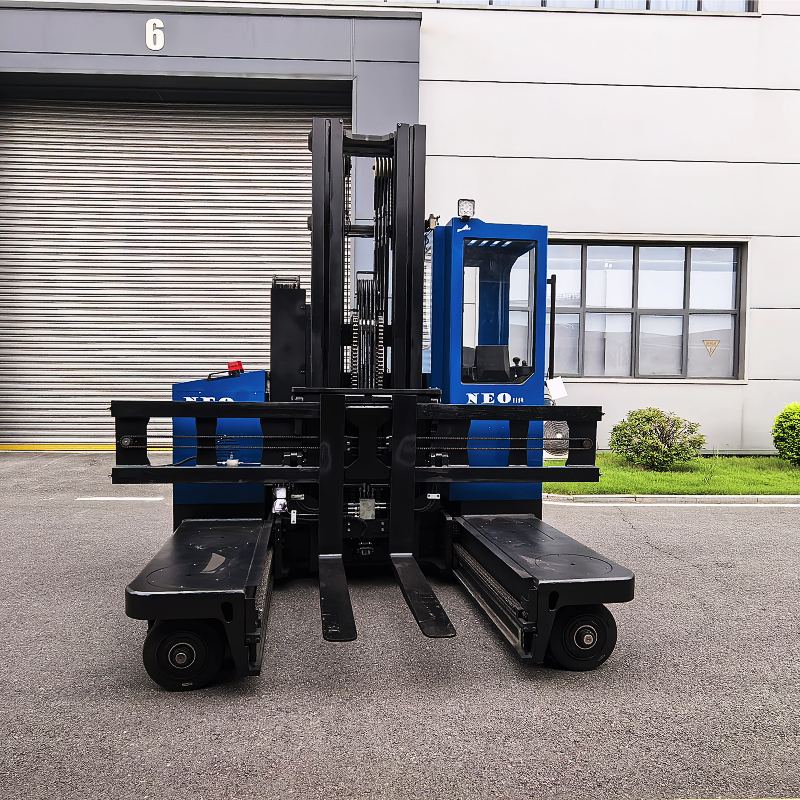
    Two buyers order the same 20 ton forklift. One lifts steel coils every day without strain; the other sees the mast flex on the first shift. The difference is rarely the truck — it is the load center and lift height. Rated capacity is measured at a stated load center and lift height. Move the load further from the fork heel, or lift higher than the rating point, and safe capacity drops. That is why a 15 Ton Heavy-duty Electric Forklift Truck must always be checked against the derated load chart rather than its headline tonnage. Start with three numbers: cargo weight, the horizontal distance from the fork heel to the load's centre of gravity, and the maximum lift height. Then add the attachment — a coil ram, clamp or spreader adds its own weight and pushes the centre further forward. For dense cargo, the answer is usually 10-50 ton heavy-duty forklift engineering: a wider wheelbase, reinforced mast and a larger counterweight, not a bigger engine on a light chassis. Where loads are long and aisles narrow, a Narrow body electric seated multi-directional forklift turns the load in place, so a shorter, lower-cost truck handles the same tonnage. For heavier long material, NEO FORKLIFT offers an Electric multi-directional forklift for long material and a Heavy duty electric multi-directional forklift with the same sideways-travel principle. Power follows duty cycle. Heavy-duty electric forklifts suit indoor, repeat-cycle work with lower energy cost; heavy-duty diesel forklifts stay the safer choice for outdoor yards, ramps and continuous 8-12 hour shifts, where a Heavy capacity diesel forklift truck keeps working through weather and gradients. NEO FORKLIFT builds both, engineered to your own load chart, with custom mast, fork and attachment options and global parts support.   FAQ What is the load center of a forklift?It is the horizontal distance from the fork heel to the load's centre of gravity. Capacity is rated at that distance. Can I lift more than the rated capacity if the load is closer to the mast?Sometimes, but only within the manufacturer's derated load chart. Never exceed the chart value. Does lift height reduce capacity?Yes. Higher lift points reduce safe capacity, especially on tall masts. Do steel coils need special equipment?Dense coils usually need a coil ram or clamp plus a matching load chart.
  • How to Choose an Explosion Proof Electric Forklift for Hazardous Areas
    How to Choose an Explosion Proof Electric Forklift for Hazardous Areas Sep 23, 2026
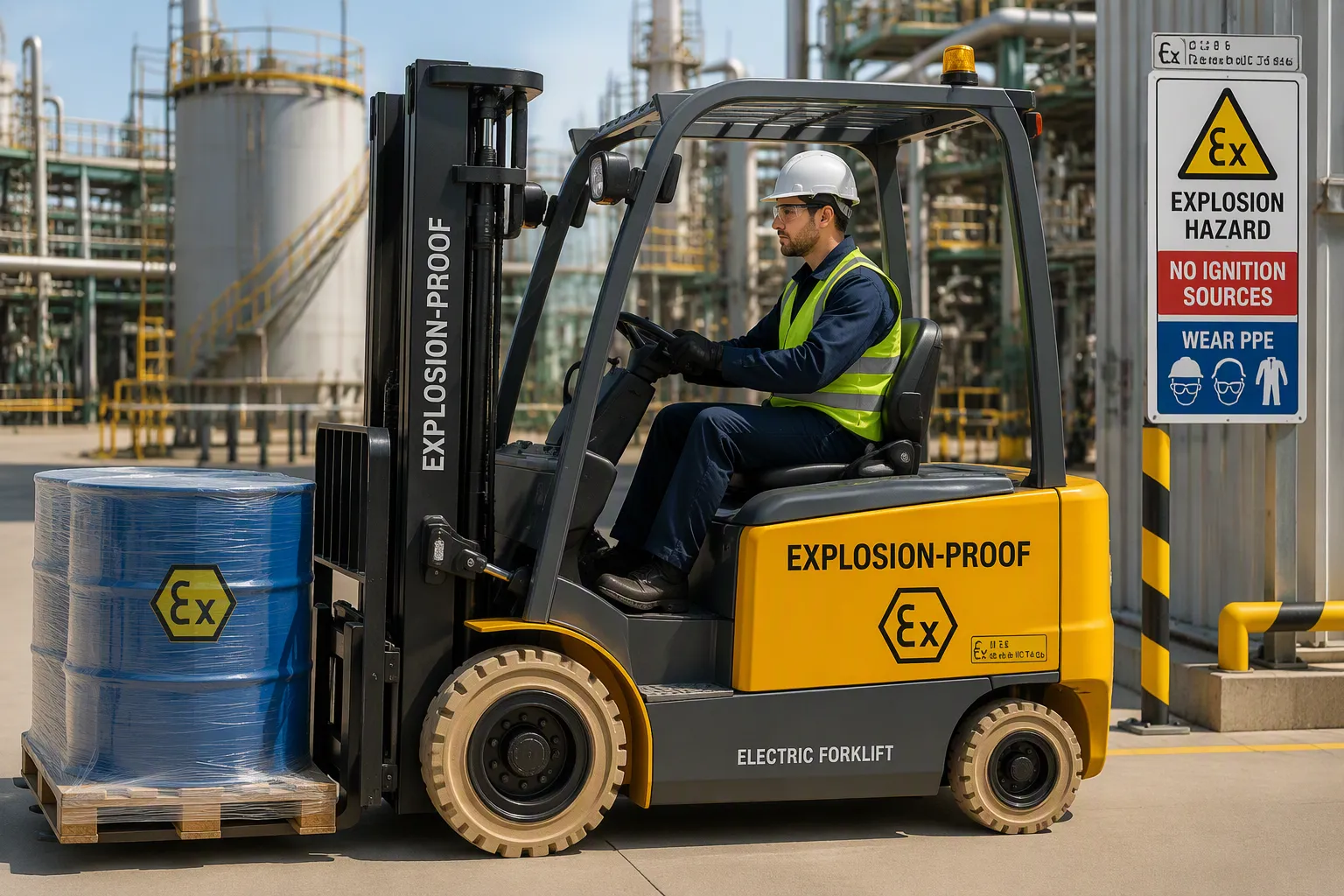
      You start by matching the certification of an explosion proof electric forklift to your hazardous area classification. The unit must suit your specific zone, gas group, and temperature class. A wrong choice creates ignition risk. Over-specifying raises cost without added safety.   Key Takeaways Match the forklift's certification to your hazardous area's zone, gas group, and temperature class to prevent ignition risks. Verify all certification markings on the forklift's nameplate and ensure they align with your area classification document. Assess your application needs like shift patterns, floor conditions, and aisle width to ensure the forklift fits your operation.   Know Your Hazardous Area Classification Before Choosing an Explosion Proof Electric Forklift Your facility's area classification document defines the risk. You must read it before you compare any explosion proof electric forklift models.   Understanding ATEX Zones and NEC Classes and Divisions ATEX is an EU directive that regulates equipment for explosive atmospheres. It uses three zones: Zone 0, 1, and 2. The NEC in the United States uses a Class and Division structure under Articles 500-504. Class I covers flammable gases. Division 1 covers continuous or intermittent presence. Division 2 covers abnormal conditions only. Feature ATEX/IECEx Zone System NEC Division System Risk granularity Three levels: Zone 0, 1, 2 Two levels: Division 1, 2 Basis of classification Probability and duration of explosive atmosphere Likelihood under normal vs. abnormal conditions Equipment markings Zone, gas group, temperature class Class, Division, Group, temperature class NEC Article 505 bridges the two systems. It lets you use ATEX/IECEx-certified equipment in US Zone 1 locations when the AHJ accepts the certification.   Identifying Gas Groups and Dust Groups Gas groups classify flammable vapors by their ignition behavior. Dust groups do the same for combustible dusts. Your classification document lists the specific group for your area. The forklift's certification must match that group exactly. Determining Temperature Classes The temperature class sets the maximum surface temperature the equipment can reach. A T4 rating means 135°C. A T6 rating means 85°C. You match the class to the ignition temperature of your substance. Temperature Class Maximum Surface Temperature T1 450°C T2 300°C T3 200°C T4 135°C T5 100°C T6 85°C Under IEC 60079-31, Zone 22 equipment must not exceed T4 (135°C). For self-heating dust layers, certification may reduce this limit to T5 (100°C). Zone 22 stackers therefore typically fall within the T4 or T5 range.   Reading Your Area Classification Document Your document lists the zone, gas or dust group, and temperature class for each area. You check these three values against the forklift's certification label. A mismatch means the unit is not safe for that location.   Match Explosion Proof Electric Forklift Specifications to Your Classification Your area classification document gives you three values: zone, group, and temperature class. Now you turn those values into a specification. Every marking on the forklift's nameplate must line up with those three values. This section walks you through each specification category you need to verify.   Explosion Protection Rating and Certification Markings Certification markings tell you exactly where a forklift can operate. You cannot rely on a sales brochure or a verbal assurance. You read the nameplate. Three major certification frameworks govern explosion proof electric forklift design worldwide. Each one uses its own language and its own logic. Certification Region Description ATEX European Union Ensures equipment is safe for explosive atmospheres, categorized by risk zones. IECEx International Global standard verifying equipment's safety in explosive environments. NEC North America Defines hazardous location classifications for industrial equipment. The NEC philosophy aims to contain explosions. The IEC philosophy focuses on preventing and containing them. US standards applicable to EX forklift electrical design include UL 1203, UL 1604, UL 583, NFPA 505, OSHA 1910.178, and ANSI. EX forklifts must be tested and certified for Class 1, Division 1, Groups C&D in accordance with NEC, UL 1203, and UL 583. International standards build on the European ATEX directives, and ongoing efforts continue to harmonize US codes into the international framework. UL 583 requires specific markings on every EX truck. You verify each one before you accept delivery. Type designation on each side in a prominent location, with a 5-inch width, yellow background, and black letters. Class and Group of hazardous location(s) for which the truck is approved (e.g., Class I, Division 1 & 2, Group D; Class II, Division 1 & 2, Group G). Maximum external operating temperature or operating temperature class (T-Code). A statement calling attention to the necessity for keeping enclosures of electrical parts and wiring tightly assembled while in hazardous areas. Name or trademark of the manufacturer, catalog designation, normal voltage rating of the battery, truck gradeability, and a schematic or pictorial circuit-wiring diagram. An ATEX marking like Ex II 2G Ex de IIB T4 Gb packs seven pieces of information into one string. You decode each piece to confirm suitability. Ex – Indicates the equipment is certified as explosion-protected and complies with ATEX/IECEx standards. II – Equipment Group II: intended for use in all places other than mines susceptible to firedamp (i.e., surface industries with potentially explosive atmospheres). 2G – Category 2G: equipment suitable for Zone 1 (gas) hazardous areas, where an explosive gas atmosphere is likely to occur during normal operation. Category 2 provides a high level of protection. Ex de – Protection concepts: 'd' = flameproof enclosure (contains internal explosion and prevents flame propagation to the surrounding atmosphere); 'e' = increased safety (additional measures to prevent excessive temperatures and sparking/arcing). IIB – Gas group IIB: equipment is suitable for atmospheres containing gases with ignition energies corresponding to group IIB (e.g., ethylene). This is a medium-level gas group; equipment marked IIB can also be used in IIA atmospheres but not in IIC (e.g., hydrogen, acetylene) unless specifically marked IIB+H2. T4 – Temperature class T4: the maximum surface temperature of the equipment will not exceed 135°C, making it safe for gases with auto-ignition temperatures above 135°C. Gb – Equipment Protection Level (EPL) Gb: high protection level for gas atmospheres, suitable for Zone 1 (and by extension Zone 2). Real-world examples show how these markings map to specific truck models. An EXF 16 explosion-protected forklift truck with self-supporting ISO forks carries the marking Ex II 2G IIB+H2 T4, Gb. This confirms Group II, Category 2G (gas), suitable for Zone 1. EXG 12, EXG 03, and EXV 12 explosion-proof forklift trucks carry Ex II 2G IIB T4. A LiTex lithium battery for ATEX Zone 1/21 carries Ex II 2G IIB+H2 T4 for gas and Ex II 2D IIIB T135°C for dust. A pressurized LiTex charger carries both ratings. An EXR 14 reach truck holds ATEX Zone 1 (2G) and 21 (2D) approval. Protection concepts vary by component and by zone. You match the concept to the zone where the component sits. Protection Concept Full Name Standard Permitted Zones Ex d Flameproof Enclosure UL/CSA 60079-1 Zone 1 or Zone 2 Ex e Increased Safety UL/CSA 60079-7 Zone 1 or Zone 2 Ex i Intrinsic Safety UL/CSA 60079-11 Zone 0, Zone 1, or Zone 2 (and Zone 20, 21, 22 for equipment listed for dust) A flameproof enclosure contains an internal explosion and stops flame from escaping. Increased safety adds measures to prevent excessive temperatures and sparking. Intrinsic safety limits energy to a level too low to ignite the atmosphere. Each concept suits different components. You confirm that the manufacturer applied the right concept to each part of the truck.   Ingress Protection and Enclosure Sealing The IP rating tells you how well the enclosure keeps out dust and water. A higher IP number means better sealing. You match the IP rating to your environment. Dusty grain facilities need a high dust ingress rating. Washdown areas need a high water ingress rating. Chemical plants may need both. The IP rating appears on the nameplate alongside the explosion protection marking. Sealing is not a one-time achievement. Batteries and electrical housings on EX trucks are sealed to contain internal sparks, but gaskets and seals degrade due to heat cycling and vibration. A truck that passed certification a year ago may no longer meet the standard today without regular inspection. Seal wear is rarely visible from the outside. Plants that rely only on visual casing inspections often miss the exact failure point that an incident investigation would identify. Several design features protect the integrity of the sealing system. You verify each one during specification review and during maintenance. Threaded wiring connections: All wiring entering EX enclosures must use threaded connections that thread deeper than typical threads, preventing loosening during operation that could make the connection unsafe or pull wiring out of the enclosure. Conduit sealing: Wiring conduits must be sealed at each connecting enclosure using EX-rated sealing epoxy, preventing an explosion from traveling between enclosures through the conduit. Threaded flame paths: Threaded paths require a minimum of five threads for NPT-type threads (varying for standard fastener threads) to keep fasteners secure and stop flame or spark propagation from the enclosure interior. Flame path cleanliness and integrity: Flame paths and surfaces must be kept free of debris, scratches, and physical flaws. Any damage or debris can enlarge or alter the flame path beyond what UL 583 deems safe. Even a small piece of paper or dust on a lid flange can shim the lid off its mating surface enough to let a spark or flame escape. Protective handling during service: Surfaces should be taped off to protect against scratches, dust, debris, or physical damage, then wiped with a mild cleaning solution before installation. You build these checks into your maintenance schedule. A sealing system that degrades without detection defeats the purpose of the certification.   Battery, Motor, and Electrical System Requirements The battery and motor are the largest energy sources on an electric forklift. They demand the most attention during specification. Battery technology affects your charging infrastructure and your safety procedures. Lead-acid electric forklifts became common indoors because they avoid exhaust. However, charging can release hydrogen. Therefore, many sites need a controlled charging room, ventilation, gas monitoring, and strict operating rules. Lead-acid electric forklifts became common indoors. They avoid exhaust. However, charging can release hydrogen. Therefore, many sites need a controlled charging room, ventilation, gas monitoring, and strict operating rules. Lithium-ion batteries offer an alternative for Zone 1 and Zone 21 environments. A LiFePO4 lithium battery meets international explosion-proof certification standards and is designed for Class I, Div 1/2 and ATEX Zone 1/21 environments. Features include a flameproof enclosure, a smart battery management system, and IP54 sealing. The lithium battery is engineered to replace traditional lead-acid batteries in ATEX Zone 1/21 environments, which indicates that lead-acid was previously used and approved under those zone classifications. Battery Technology Approval Evidence Lead-Acid Implicitly approved – the lithium battery is engineered to replace traditional lead-acid batteries in ATEX Zone 1/21 environments, indicating lead-acid was previously used and approved under those zone classifications. Lithium-Ion (LiFePO4) Explicitly approved – meets international explosion-proof certification standards and is designed for Class I, Div 1/2 and ATEX Zone 1/21 environments. Features include flameproof enclosure, smart BMS, and IP54 sealing. The motor must carry its own explosion protection rating. You check that the motor's marking matches the zone where the truck operates. The same rule applies to controllers, contactors, lights, horns, and every other electrical component on the truck. Wiring between components must follow the protection concept for each zone. Intrinsically safe circuits require barriers and specific cable types. Flameproof circuits require sealed conduit and threaded entries. You confirm that the manufacturer documented the protection concept for every circuit.   Load Capacity, Lift Height, and Attachment Compatibility Explosion protection adds weight and changes the truck's center of gravity. You cannot assume that a standard forklift's load chart applies to an EX version. The data plate on the EX truck states the rated capacity at a given load center. You compare that rating to your heaviest load and your actual load center. A longer load shifts the center of gravity forward and reduces the safe capacity. You check the derated capacity, not the nominal capacity. Lift height affects stability. A high lift with a heavy load demands a larger counterweight and a wider stance. Explosion-proof components may limit the available counterweight space. You verify the truck's capacity at your maximum lift height, not just at ground level. Attachments change the load geometry. A clamp, a rotator, or a side shifter moves the load center and adds weight. You confirm that the attachment carries its own explosion protection rating if it operates in the hazardous area. Forks made from spark-resistant materials, such as bronze alloys, reduce ignition risk from impact. You verify that the attachment manufacturer certified the attachment for your zone, group, and temperature class. You also check the aisle width and turning radius. An EX truck may have a larger footprint than a standard model because of added enclosures and sealing. You measure your narrowest aisle and compare it to the truck's right-angle stacking dimension. A truck that cannot maneuver safely in your space creates a different kind of hazard.   Assess Application Needs and Verify Certifications Evaluating Shift Patterns, Duty Cycles, and Charging Areas Start by mapping shift patterns and duty cycles. An explosion proof electric forklift must handle peak demand without overheating. Continuous multi-shift operation requires a larger battery or a spare rotation plan. Intermittent use permits a smaller battery. Charging areas deserve equal attention. Charging releases hydrogen gas. You must ventilate the area adequately under OSHA's 29 CFR 1910.178. Keep hydrogen below 1% concentration. Install spark-proof exhaust fans at the highest point. Place fresh-air louvers near the floor. Use hydrogen detectors that trigger audible and visual alarms and auto-activate exhaust fans. Adequate ventilation must be provided for battery charging areas to disperse hydrogen gas under 29 CFR 1910.178. If hydrogen is detected, workers must stop charging, ventilate the area, and evacuate if necessary. Maintain ventilation with six to ten air changes per hour. Prohibit smoking and ignition sources within 20 feet of charging equipment. Check ventilation performance regularly.   Reviewing Environment, Floor Conditions, and Aisle Width Your environment sets several specifications. Dusty facilities need high ingress protection. Washdown areas demand watertight enclosures. Chemical plants may need both. Floor conditions affect stability. Uneven floors reduce capacity and raise tipping risk. Measure your narrowest aisle against the truck's right-angle stacking dimension. A wider EX truck cannot maneuver in tight spaces.   Confirming Third-Party Approvals and Documentation Documentation proves compliance for your explosion proof electric forklift. Collect these items before delivery: Documentation What to Verify Original certification ATEX or IECEx paperwork Protection concept Explosion protection method Zone suitability Rating for your zone Temperature class T-code matching your area Maintenance records Service dates and parts Audit records Compliance verification   Using a Step-by-Step Selection Checklist Follow a systematic approach: Confirm zone, gas group, and temperature class. Verify certification markings on the nameplate. Check the IP rating. Match battery and motor protection. Compare derated load capacity at maximum lift height. Measure aisle clearance. Review the documentation folder. Consult a qualified explosion protection specialist before purchase. They confirm compliance and prevent costly mistakes.   Select the explosion proof electric forklift whose certification matches your hazardous area classification. Verify the gas group, temperature class, ingress protection, and third-party approvals. Assess load, lift height, shift patterns, and environment to ensure operational fit. Consult a qualified explosion protection specialist before purchase to confirm compliance and avoid costly mistakes.   FAQ What is the difference between ATEX Zone 1 and Zone 2 for explosion proof electric forklifts? Zone 1 requires equipment rated for likely explosive atmospheres during normal operation. Zone 2 covers abnormal conditions only. You match your forklift certification to your specific zone. Can you use a standard electric forklift in a hazardous area? No. A standard electric forklift lacks explosion protection. Sparks from motors, wiring, or connectors can ignite flammable gases or dust. You need a certified explosion proof unit. How often should you inspect explosion proof electric forklift seals and flame paths? You inspect seals and flame paths regularly, typically after every 500 operating hours. Heat cycling and vibration degrade gaskets. Damaged flame paths let sparks escape. Schedule inspections based on your duty cycle.
  • How Long Does a Heavy-Duty Electric Forklift Battery Last per Shift?
    How Long Does a Heavy-Duty Electric Forklift Battery Last per Shift? Sep 23, 2026
    Battery runtime is the first question buyers ask before replacing diesel with electric in heavy-duty operations. On a 10–50 ton truck, shift length is never decided by the battery alone — load weight, lift height, travel distance and duty cycle all pull energy out of the pack. A 20-ton unit handling steel coils at full lift drains far faster than the same truck moving lighter pallets inside one bay. Sizing comes first. Large lead-acid packs often deliver six to eight hours of continuous work in medium duty, while modern lithium packs hold voltage longer and support a lithium battery forklift charging strategy built on short top-ups instead of one long overnight charge. That is why opportunity charging for electric forklifts has become standard in two- and three-shift logistics: operators plug in during breaks and shift changes and keep the pack between 30% and 80%. Fleets that run this way usually pair a heavy duty forklift with lithium battery with a heavy duty electric multi-directional forklift when loads are long or unusually bulky. Before you compare quotes, ask the supplier to size the pack against your real duty cycle. Getting heavy-duty electric forklift battery runtime right usually means matching the right 20-ton electric forklift battery capacity to lift height and travel distance rather than trusting a catalogue average. In practice that means comparing a 15 Ton Heavy-duty Electric Forklift Truck with electric counterbalance forklifts for heavy-duty lifting, or stepping up to an Electric multi-directional forklift for long material when the load is longer than the forks. At NEO FORKLIFT we size every pack — counterbalance, multi-directional, VNA, tow tractor or custom warehouse truck — around multi-shift forklift battery planning, so runtime matches your roster, not the other way round. Send us your shift pattern and load data, and our engineers will recommend the voltage, capacity and charging window that keeps your fleet moving.   FAQ Q: How many hours can a heavy-duty electric forklift run on one charge?A: Medium-duty 10–50 ton trucks typically deliver 6–8 hours per charge; continuous heavy lifting can reduce this to 4–5 hours, which is why break-time charging matters. Q: Is lithium or lead-acid better for multi-shift work?A: Lithium tolerates opportunity charging and needs no watering or battery changes; lead-acid suits single-shift duty with a strict charging schedule. Q: Can I keep using my existing charger?A: Only if voltage, current and connector match the new pack — mismatched chargers shorten battery life. Q: Does cold storage reduce battery runtime?A: Yes. Below freezing, usable capacity can drop noticeably, so specify cold-store rated packs when needed. Q: How do I know which capacity to order?A: Share your load weight, lift height and daily operating hours; our team sizes the pack to that profile.
  • How to Choose a Custom Electric Forklift Manufacturer for Non-Standard Applications
    How to Choose a Custom Electric Forklift Manufacturer for Non-Standard Applications Sep 16, 2026
    You need a custom electric forklift for your unique application. Start by defining your non-standard requirements. Then evaluate each manufacturer's engineering depth, customization track record, quality certifications, and post-sale support. Custom electric forklifts succeed or fail on engineering discipline, not price alone. A wrong partner means downtime, safety risk, and sunk capital. Vetting must be rigorous and sequential. The right customized material handling equipment partner validates your application from first spec to final delivery.   Key Takeaways Write down your exact load weight, work environment, and needed attachments before talking to manufacturers. Choose a manufacturer with in-house engineers, strict testing, and ISO 9001 and 14001 certifications. Compare total cost of ownership, not just upfront price, and ask for references from similar projects.   Define Your Non-Standard Application Requirements Every successful engagement begins with precise documentation of your application needs. You cannot expect a manufacturer to deliver reliable customized material handling equipment if you cannot define what makes your operation unique. Three core areas require your attention. Document Load Capacity and Load Center You must record the exact weight of every load your forklift handles. Specify the maximum load capacity and the load center distance. Standard forklifts often fail when loads shift or exceed design limits. Capacity upgrades and reinforced chassis designs depend on accurate numbers. Provide these specifications to your manufacturer. Map Environmental and Duty Cycle Conditions Your operating environment determines critical design parameters. Cold-storage facilities require specialized electrical components. Explosive environments demand explosion-proof configurations. Corrosive settings need corrosion-resistant materials. Your duty cycle also matters. Record shifts per day, operating hours, and travel patterns. Non-Standard Requirement Category Description Fork and attachment modifications Extended forks and specialized attachments tailored to unique load handling Capacity upgrades Increased load capacity and reinforced chassis for heavier loads Mast and structural redesign Mast redesign and reinforced chassis for heavier loads or unusual lifting heights Environment-specific configurations Cold-storage, explosion-proof, and corrosion-resistant designs for extreme environments Automation integration AGV-ready automated systems for unmanned operations Dimensional/space constraints Tailored electric stackers and reach trucks for narrow warehouse aisles Heavy-duty applications Custom carriers, coil handlers, and mold handling carts for 1–30 ton loads List Attachment and Integration Needs You must catalog every attachment your operation requires. Common custom attachments include: Side shifter Clamp attachment Fork rod Rotator Extended fork arm Anti-slip fork You may also require automation integration for AGV-ready systems. A complete list allows your customized material handling equipment partner to engineer the correct hydraulic and control systems from the start. Missing details lead to costly retrofits later.   Evaluate Engineering Depth and Customized Material Handling Equipment Capabilities Engineering depth separates a true custom manufacturer from a standard forklift supplier with a paint job. You need a partner who designs, tests, and validates every component for your specific application. This section shows you how to assess that capability before you commit capital.   Confirm In-House Engineering and Design Tools Ask every candidate manufacturer one critical question: Do you perform engineering work in-house or outsource it? In-house engineering gives you direct access to the people who design your customized material handling equipment. Outsourced engineering adds communication layers, delays, and accountability gaps. A capable manufacturer uses advanced design tools. Look for these capabilities during your evaluation: Finite Element Analysis (FEA) for structural stress and deflection evaluation Computational Fluid Dynamics (CFD) for thermal and airflow analysis Motion and kinematic analysis for moving component evaluation 3D CAD modeling for every component in the system Electrical, hydraulic, and pneumatic schematics Geometric Dimensioning and Tolerances (GD&T) development Design for Assembly (DFA) and Design for Manufacturing (DFM) services These tools allow engineers to digitally evaluate all moving components throughout their full range of motion. They identify interferences, clearance issues, and unintended interactions early in the design process. Virtual tests enable rapid design iterations. This approach reduces physical prototyping time and cost significantly. CAx software serves as an integration platform for simulation and analysis tools. Engineers transition from design to analysis without complex data transfers. This integration ensures seamless data exchange between different engineering domains. It promotes collaboration and eliminates manual data re-entry. Emerging trends include cloud-based solutions, artificial intelligence integration, and multi-disciplinary optimization. You should also examine the manufacturer's actual project portfolio. A proven track record demonstrates real engineering capability. Consider these examples of customized material handling equipment: Electric die handler and mold transfer truck: Handles molds up to 600mm x 600mm and as small as 500mm x 500mm, supports low-profile dies at 70mm height, and uses an advanced electric push-pull mechanism for millimeter-perfect docking into industrial furnaces. Stand-up counterbalanced floor crane with telescopic boom: Features a boom rotating a full 180 degrees, a telescopic extension for overhead lifting over obstacles, and a zero-outrigger counterbalanced chassis. Electric forklift battery handling stacker and transfer cart: Equipped with a 1.5KW vertical drive motor, a 2.2KW power unit, and a 24V/210Ah lead-acid battery pack, with a dedicated gripping mechanism for multi-ton battery units. Electric roll handler with 360-degree rotation and wireless remote control: Uses a pneumatic expanding air shaft that grips rolls from the inner core, provides full 360-degree continuous rotation, supports loads up to 1 ton, and includes wireless remote operation. CDD10-BF electric roll handler with push-off: Achieves 500mm effective stroke with 2-3mm positioning accuracy, maximum electric lifting height of 1950mm, effective load length up to 960mm, customizable arm dimensions, and a 40CR lead screw for vibration-free lifting. These examples show what deep engineering capability looks like in practice. The manufacturer conducts comprehensive factory tours and technical briefings to understand client-specific operational challenges. They address ultra-narrow aisles, zero-vibration mold handling, and millimeter-level docking accuracy. Rapid prototyping and robust assembly line capabilities transform unique requirements into high-performance machinery. The company actively absorbs advanced domestic and international technology. They refuse to compromise on core mechanical components by using internationally renowned brand parts. They provide tailor-made custom services based strictly on specific customer needs.   Review Prototyping, Testing, and Safety Compliance Prototyping and testing validate your custom design before full production. A rigorous manufacturer builds physical prototypes and subjects them to real-world conditions. They test load capacity, stability, braking performance, and electrical safety. They verify every attachment and integration point. Safety compliance is non-negotiable for custom electric forklifts. Compliance operates at two levels: product standards and workplace regulations. You must verify both. Standard/Regulation Legal Status Relevance for Custom Electric Forklifts OSHA 29 CFR 1910.178 Mandatory in U.S. workplaces Requires employer responsibilities for safe operation, including pre-shift checks, training, and written manufacturer approval for any modification or attachment that affects capacity or safety. Custom electric forklifts must have updated capacity plates. ANSI/ITSDF B56.1 Industry consensus standard (not law itself) Often used as a technical reference for design and safety in North America. Buyers must confirm current requirements with the manufacturer and local authorities; not a standalone mandatory certificate. ISO 3691 series International voluntary standard Provides global safety requirements and verification principles for industrial trucks. Does not replace national laws; serves as a design baseline but must be complemented by local mandatory regulations. CE marking (EU Machinery Directive) Mandatory for placing machinery on the European Economic Area market Requires product conformity documentation, safety labels, and technical files. Not interchangeable with OSHA; a forklift sold in the EEA must carry valid CE marking. Custom configurations must be reassessed. National/local regulations Vary by country (e.g., emissions, electrical, inspections) May add country-specific mandatory requirements for battery charging, hazardous locations, operator licensing, and periodic inspections. Custom electric forklifts must be evaluated against the destination country's rules. Compliance is layered. A custom electric forklift must meet both product-level standards (ISO, CE) and workplace-level regulations (OSHA, local rules). Modifications and attachments always require manufacturer approval to maintain compliance. Ask your candidate manufacturer for documentation of their testing protocols. Request evidence of type testing and safety validation. A serious manufacturer welcomes this scrutiny.   Verify Quality Certifications and Standards Quality certifications provide independent verification of a manufacturer's processes and products. You should prioritize manufacturers with recognized certifications. These credentials reduce risks and ensure forklifts meet legal and operational requirements. Look for these certifications during your evaluation: ISO certifications (like ISO 9001) that demonstrate consistent quality management Safety regulation compliance such as OSHA or ANSI standards Environmental certifications like ISO 14001 that indicate eco-friendly manufacturing The following table explains what each certification means for a custom electric forklift manufacturer: Certification Role for a Custom Electric Forklift Manufacturer Key Benefits ISO 9001 The foundational Quality Management System (QMS) standard — described as the bedrock and most critical standard for a reputable forklift manufacturer. Ensures design reliability via structured design reviews and risk assessments; enforces full component traceability (critical for safety recalls); mandates inspection of key components (mast assembly, hydraulic systems, chassis welding); drives continuous improvement to reduce defects and extend product lifespan. ISO 14001 Environmental Management System (EMS) standard — increasingly vital for sustainability-focused buyers. Reduces ecological footprint through strict energy, water, and waste protocols; promotes eco-friendly materials (low-VOC paints, recyclables); guides compliance with battery disposal and recycling standards — a key differentiator for electric forklift buyers with ESG goals. Verification (both) Buyers should verify certificate validity (issue/expiry dates, authenticity via certification body) and confirm the scope covers Design, Manufacturing, and Sales of Forklift Trucks — not just an isolated department. Choosing an ISO-certified manufacturer reduces downtime, stabilizes the supply chain, and lowers Total Cost of Ownership (TCO). After-Sales (ISO 9001) Extends quality commitment beyond the factory to service and maintenance. Guarantees genuine, compatible spare parts; ensures efficient, standardized service response; standardizes technical documentation and operator/technician training. Electric-Specific (ISO 9001 + 14001) Quality systems focus on the Battery Management System (BMS), electrical safety, and charging protocols for high-voltage systems. Mitigates risks associated with high-voltage systems; ensures peak performance and longevity of the power source; supports responsible handling of hazardous battery materials. Beyond ISO certifications, you should verify specific manufacturing credentials. These documents confirm a manufacturer's legal standing and technical capability: Certification / License Issuing Authority Significance Trademark Registration Certificate Intellectual Property Office Confirms official brand ownership and legal standing Special Equipment Manufacturing License State Administration for Market Regulation Mandatory qualification to legally manufacture special equipment Type Test Certificate Construction Machinery Quality Inspection and Testing Center Validates products passed rigorous engineering type testing ISO 14001 certification ensures strict control over lead, acid, and manufacturing waste during production. For OEMs, partnering with a certified supplier reduces environmental compliance risks, protects brand reputation, and guarantees seamless entry into markets with stringent ESG requirements like Europe and North America. A manufacturer with dual-track ISO 9001 and ISO 14001 quality systems uses automated production equipment. Every production batch undergoes total inspection for internal resistance, exact discharge capacity, and container seal integrity. You should verify certificate validity by checking issue and expiry dates. Confirm authenticity through the certification body. Ensure the scope covers design, manufacturing, and sales of forklift trucks — not just an isolated department. Prioritize manufacturers with proven experience, flexible customization, strong support, and recognized certifications. This approach secures reliable and compliant forklifts for your operation.   Compare Quotes, Lead Times, and After-Sales Support Price alone does not determine the best partner. You must weigh cost against value, verify support infrastructure, and confirm real-world performance through references. Weigh Cost Against Value and Risk A low quote often signals hidden risks. You should evaluate total cost of ownership (TCO) instead of sticker price. TCO captures every dollar from acquisition to decommissioning. Industry data for 2026 shows electric fleets deliver a 43% reduction in TCO over a five-year lifecycle compared to internal combustion models. Electric powertrains offer a 5–7 year lifespan with minimal degradation. The real metric is cost per operating hour, not upfront price. Lead times also affect your planning. Standard stock models ship in 2–4 weeks. Custom specifications, OEM branding, or non-standard battery configurations require 6–10 weeks. CE or specific market certification documentation adds additional time. Total timeline from confirmed purchase order to delivery runs 10–16 weeks. Customized forklifts with special attachments or unique power systems need 8–12 weeks or more. Assess Spare Parts, Service Network, and Warranty Terms You need guaranteed access to genuine spare parts. Ask about local spare-parts depots. A manufacturer relying only on direct factory shipping creates downtime risk. Warranty terms shorter than 12 months or heavily restricted coverage represent red flags. Your customized material handling equipment partner should provide standardized service response and genuine, compatible components. Request References and Case Studies from Similar Applications You must verify a manufacturer's track record. Request references from customers with similar applications. Ask for case studies documenting field performance. A trustworthy manufacturer allows factory visits and provides documented results. Walk away if a supplier dodges technical questions, cannot produce genuine project references, or emphasizes price alone rather than application fit.   Define your specs, vet engineering depth, verify certifications, check support, compare value, and confirm references. The best manufacturer validates your unique application from first spec to final delivery. Use this pre-purchase checklist: Document load, environment, and attachment needs. Confirm in-house engineering and testing. Verify ISO and safety certifications. Assess parts, service, and warranty. Request references from similar projects.   FAQ How long does a custom electric forklift order take? Custom electric forklifts typically require 8 to 12 weeks. Complex attachments or unique power systems may extend this timeline. Standard stock models ship faster. Which certifications should a custom forklift manufacturer hold? You should verify ISO 9001 and ISO 14001 certifications. Also confirm safety compliance with OSHA or ANSI standards. Check the Special Equipment Manufacturing License for legal standing. How do you evaluate a manufacturer's engineering capability? Ask about in-house design tools like FEA and 3D CAD. Request case studies from similar applications. A capable manufacturer provides factory tours and technical briefings.
  • Heavy-Duty Forklift Maintenance: How Do You Prevent Costly Downtime?
    Heavy-Duty Forklift Maintenance: How Do You Prevent Costly Downtime? Sep 14, 2026
    Downtime is the most expensive cost of owning a heavy-duty forklift. One hydraulic leak or a scored mast chain can stop a steel coil line for a whole shift. At 10-50 ton capacity most failures are predictable, and a disciplined heavy-duty forklift maintenance schedule catches them long before they cost you a shift. Daily, before the first lift: check tyres, look for hydraulic weeping under the mast, and test brake pedal travel and warning lights. Ten minutes here prevents a cracked mast later. Weekly, the priority is heavy load forklift hydraulic inspection — oil level and colour, hose fittings, cylinders and mast chains. Dark or foamy oil is the first sign of overheating in 24/7 duty, and changing oil is far cheaper than changing a pump. Monthly, on electric trucks, electric forklift battery care drives availability: water levels or the state-of-charge window, charger terminals, and thermal behaviour under load. Treating preventive maintenance for 10-50 ton forklifts as a budget line, not an afterthought, is what keeps a fleet working in the yard. Some failures are designed in. Moving a 12-ton load on a 10-ton truck, or pushing a diesel unit through a deep cold-store cycle, always ends in downtime. Match the machine to the duty cycle: a 15 Ton Heavy-duty Electric Forklift Truck for dense indoor steel handling, an Electric heavy-duty forklift truck where zero emissions matter, a Mine use heavy duty diesel forklift truck for dusty outdoor yards, and a Heavy duty electric multi-directional forklift when loads are long and aisles are tight. Where long material dominates, an Electric multi-directional forklift for long material can replace several counterbalance trucks. NEO FORKLIFT builds 10-50 ton heavy-duty electric and diesel forklifts, 3-8 ton electric multi-directional forklifts, electric VNA forklifts, heavy-duty electric tow tractors and custom electric warehouse trucks — supported by spare-parts planning and remote technical guidance for long-term forklift downtime reduction. Every NEO unit is specified around your load, aisle and shift pattern, so the maintenance schedule you write suits the truck you actually run. How often should a heavy-duty forklift be serviced? Daily visual checks, weekly hydraulic and brake checks, and a full service every 250-500 operating hours, adjusted for dust, heat and shift length. What is the first sign of hydraulic trouble on a 10-50 ton forklift? Dark or foamy hydraulic oil, slow mast lift, or weeping around fittings and cylinders — early signals that a seal or hose is failing. Can preventive maintenance really cut downtime? Yes. Planned inspections replace emergency breakdowns, and a worn hose replaced during a weekly check rarely becomes an unplanned production stop. Does NEO FORKLIFT supply spare parts for heavy-duty models? Yes. NEO FORKLIFT supports 10-50 ton electric and diesel trucks with spare-parts planning and remote technical guidance after delivery.
  • Multi-Directional Forklift vs Standard Forklift: Which Handles Long Loads Better?
    Multi-Directional Forklift vs Standard Forklift: Which Handles Long Loads Better? Sep 08, 2026
    Steel tubes, aluminum profiles, timber, and precast parts are long, heavy, and awkward to move. A standard counterbalance truck swings its rear wheels, so every load needs a wide turning radius and extra-wide aisles. This is where the multi-directional forklift vs standard forklift comparison really matters for a busy yard. An electric multi-directional forklift turns all four wheels through 90 degrees and drives sideways, keeping the load aligned with the direction of travel. In the 3-8 ton class, a NEO FORKLIFT multi-directional forklift for long loads carries 6-12 meter stock straight down aisles a standard truck could never enter, often halving the aisle width you need. For heavier material, NEO also builds an electric multi-directional forklift for long material and a heavy duty electric multi-directional forklift, so long material handling with electric multi-directional forklift is possible in one straight pass. Less swinging means fewer collisions, less rack and floor damage, and safer handling beside storage racks and workstations. NEO matches the chassis to the job: a wide body electric multi-directional forklift adds stability for long, bulky bundles, while the electric multi-directional forklift with rubber tires variant copes well on hard outdoor ground. These trucks suit steel service centers, extrusion plants, timber yards, and prefab concrete factories, indoors or out. If your loads are compact and aisles are already wide, a standard truck stays the cheaper tool; when material is long, stored deep, and moved often, the multi-directional design pays back quickly. NEO FORKLIFT builds each unit around the application - mast height, fork length, side-shift, and options can be tailored while electric forklift sideways travel keeps emissions and noise low inside the plant. What is the difference between a multi-directional forklift and a standard forklift? A standard forklift steers by turning the rear wheels, which needs a large turning radius. A multi-directional forklift rotates its wheels 90 degrees and travels sideways, so long loads move straight along the aisle. What loads suit an electric multi-directional forklift? Long, heavy items - steel pipe, aluminum profiles, timber, and precast panels - typically in the 3-8 ton range handled by NEO FORKLIFT electric multi-directional models. Can a multi-directional forklift replace a standard counterbalance forklift? Not for every job, but for long-load storage and retrieval it often replaces several counterbalance trucks and frees up large amounts of floor space. Are NEO FORKLIFT multi-directional forklifts available with electric power? Yes, the 3-8 ton multi-directional models are fully electric with zero emissions, quiet operation, and low energy cost per move.
  • What Is a VNA Forklift and How Much Storage Space Can It Save?
    What Is a VNA Forklift and How Much Storage Space Can It Save? Sep 01, 2026
    Warehouse space costs money — every square meter lost to wide aisles is storage you pay rent for but cannot use. A VNA forklift is engineered to solve exactly that problem. But what is a VNA forklift, and how much space can it really save? This guide explains how these trucks work and whether they fit your operation. A very narrow aisle forklift works in aisles as tight as 1.5–2 meters, about half the width a standard counterbalance truck needs. Instead of steering through turns, the truck follows rail or wire guidance while the forks rotate 180 degrees to pick and place pallets on both sides of the aisle without turning around. That rotation is the key: more pallet positions in the same footprint, often 20–40% higher warehouse storage density. VNA trucks are not for every job. They suit high-rack distribution centers, cold stores, and facilities with thousands of pallet positions. In a cold store, a very narrow aisle forklift for cold warehouse keeps aisles tight even at low temperatures, while a high lift VNA forklift truck reaches the top rack levels with precise positioning. For loads in the 3-8 ton class with lift heights up to 9-14 meters, an electric VNA forklift from NEO FORKLIFT delivers precise, emission-free operation indoors — quiet, energy-efficient, and gentle on floors. A warehouse using electric VNA forklift gains those extra pallet positions without building a single extra meter. Pair a VNA truck with the right racking and aisle guidance, and you can often defer a building extension for years. For long materials and mixed layouts, NEO FORKLIFT's narrow aisle warehouse forklift range is complemented by an electric multi-directional forklift for long material and a narrow body electric seated multi-directional forklift for sideways travel in unguided aisles. FAQ What is the difference between a VNA forklift and a standard forklift? A VNA forklift works in aisles as narrow as 1.5-2 meters, using rail or wire guidance and rotating forks, so it stores pallets on both sides of the aisle without turning around. How much space can a VNA forklift save? Typical warehouses gain 20-40% more pallet positions by narrowing aisles from 3.5-4 meters to under 2 meters. Are VNA forklifts electric? Most VNA trucks are electric. NEO FORKLIFT's electric VNA forklifts produce zero emissions, run quietly, and suit indoor high-rack operations. Can a VNA forklift replace a multi-directional forklift? Not entirely. VNA trucks are optimized for straight, guided high-rack aisles, while electric multi-directional forklifts handle long loads and unguided narrow aisles with sideways travel. Does NEO FORKLIFT customize VNA forklifts? Yes — capacities, lift heights, cab options, and guidance systems can be tailored to your racking layout.
  • Heavy Duty Diesel Forklift: How to Choose the Right One for Your Operation
    Heavy Duty Diesel Forklift: How to Choose the Right One for Your Operation Aug 25, 2026
    Moving steel coils, concrete blocks, or shipping containers demands more than a standard forklift — it demands a heavy duty diesel forklift built to handle 10 to 50 tons day after day. With so many configurations on the market, choosing the wrong machine can mean downtime, safety risks, and wasted investment. This guide covers the key factors to evaluate before you buy. Match the capacity to your heaviest load Never size a forklift to your average load — size it to your heaviest one. A 10 ton diesel forklift suits daily handling of steel beams and machinery, while 25-50 ton models are engineered for container yards, precast concrete plants, and steel mills. Always include the weight of attachments and the load's center of gravity in your calculation. For mining and quarry operations, a Mine use heavy duty diesel forklift truck is built with reinforced masts and heavy-duty tires to survive abrasive dust and rough terrain. Choose the capacity and configuration that matches your actual working conditions, not just the brochure. Check the mast, carriage, and hydraulics A heavy duty forklift mast must resist deflection under full load. Look for twin or triple-stage masts, reinforced carriages, and heavy-duty hydraulic cylinders with smooth, controlled lift and tilt. NEO FORKLIFT's heavy lift truck series uses high-strength steel structures and precision hydraulic systems for stable, reliable operation in the toughest yards. Diesel power vs. electric alternatives Diesel remains the first choice for outdoor heavy lifting because of its high torque, fast refueling, and endurance on long shifts. That said, electric models are gaining ground in indoor and emission-sensitive applications. NEO FORKLIFT offers both heavy duty diesel and electric forklifts, so you can match the power source to your site. For long materials such as pipes, profiles, and lumber, an Electric multi-directional forklift for long material can travel sideways in narrow aisles, while a Heavy duty electric multi-directional forklift handles the heaviest long loads without sacrificing maneuverability. Serviceability and spare parts A 50 ton forklift that sits idle costs more than its purchase price. Choose a supplier with quick parts availability, a global service network, and simplified maintenance access. Ask about engine brand, transmission, and warranty coverage before signing. Operator comfort and safety Long shifts in a heavy machine are demanding. Look for an enclosed cab with good visibility, ergonomic controls, and standard safety features like load backrests, overhead guards, and audible alarms. Why choose NEO FORKLIFT NEO FORKLIFT specializes in 10-50 ton heavy duty diesel and electric forklifts, electric multi-directional forklifts, and custom warehouse trucks. Buying direct gives you China factory price heavy-duty diesel forklift value with High quality chinese heavy duty diesel forklift engineering standards. Every machine is built around real-world loading conditions, with rigorous quality control and responsive after-sales support. Contact us to discuss your application and get a tailored recommendation. FAQ What is the difference between a heavy duty forklift and a standard forklift? Heavy duty forklifts are rated from about 10 tons upward, with reinforced masts, larger tires, and stronger drive systems. They are built for continuous outdoor work with heavy loads. Can a 10 ton diesel forklift lift more with attachments? Attachments reduce effective capacity. Always subtract the attachment weight from the rated capacity and keep the load within the stated center of gravity. How often should a heavy duty forklift be serviced? Follow the manufacturer's schedule, typically every 250-500 operating hours. Daily checks of hydraulics, tires, and brakes prevent costly breakdowns. Are electric heavy forklifts as powerful as diesel? Modern electric heavy forklifts deliver comparable lifting performance with lower emissions and running costs, making them a strong option for indoor and mixed-use sites. How long does a heavy duty forklift last? With proper maintenance, a heavy duty diesel forklift can operate reliably for 10-15 years or more, making it a long-term investment for material handling operations.
  • What Is a Heavy-Duty Electric Tow Tractor and When Do You Need One?
    What Is a Heavy-Duty Electric Tow Tractor and When Do You Need One? Aug 18, 2026
    Moving heavy loads across a large plant or distribution center is not the same as lifting them. When goods travel hundreds of meters between workstations, a heavy duty electric tow tractor often does the job faster, cheaper, and safer than a forklift. A tow tractor, or tugger, pulls wheeled trailers instead of lifting. NEO FORKLIFT builds electric tow tractors for heavy industrial use from 5 to 50 tons capacity — zero exhaust emissions, low noise, and ideal for warehouses, airports, steel plants, and container yards. For trailer-train operations, an electric heavy-duty semi-trailer towing tractor pulls loaded semi-trailers and long goods trains across the yard. When should you choose a tow tractor instead of a forklift? If drivers travel more than they lift, loads move on trailers, or one operator should move several pallets per trip, towing wins. A tow tractor vs forklift comparison typically shows 30–50% lower energy use. The load-bearing electric heavy-duty towing tractor handles the heaviest trailing loads, while NEO FORKLIFT also offers custom electric warehouse trucks and heavy electric or diesel forklifts for every task. Daily checks on brakes, couplings, and battery charge — plus service every 500 hours — keep a tow tractor running for years. For mixed fleets, an electric heavy-duty towing tractor truck can be specified with custom couplings and cabs. Q: How much can an electric tow tractor pull?A: NEO FORKLIFT tow tractors pull 5 to 50 tons of trailing load, depending on model, grade, and trailer configuration. Q: Can an electric tow tractor replace a forklift?A: Not for lifting, but for long-distance horizontal transport it often replaces forklift travel, freeing forklifts for stacking duties. Q: Can tow tractors be customized?A: Yes — NEO FORKLIFT offers custom couplings, cabs, and capacities for special applications.
1 2 3

A total of3pages

Need Help? Chat with us

leave a message
For any request of information or technical support, fill in the form. All fields marked with an asterisk* are required.
Submit
Looking for FAQs?
Contact us #
+86-18302189328

Our hours

Mon 11/21 - Wed 11/23: 9 AM - 8 PM
Thu 11/24: closed - Happy Thanksgiving!
Fri 11/25: 8 AM - 10 PM
Sat 11/26 - Sun 11/27: 10 AM - 9 PM
(all hours are Eastern Time)

home

products

whatsApp

Contact Us